Am I autistic? #3 Finally understanding the Autism Spectrum
On my journey exploring autism and whether I can find myself somewhere in this landscape, my second problem was understanding the autism spectrum people are talking so much about.
By the way, I’ve also understood now that many autists don’t like to be characterised as “on the spectrum”. Because if you’re on something, this something must be outside you. And autism is definitely an important part of who you are.
However, comprehending the spectrum concept correctly was still essential to fully grasp what autism is on this expedition of mine.
How I misunderstood autism – the one-dimensional spectrum
I did understand, of course, that when people were talking about the autism spectrum, they were trying to say that autism isn’t one single thing. It’s not the same for everyone.
So, I imagined a one-dimensional spectrum like this one:
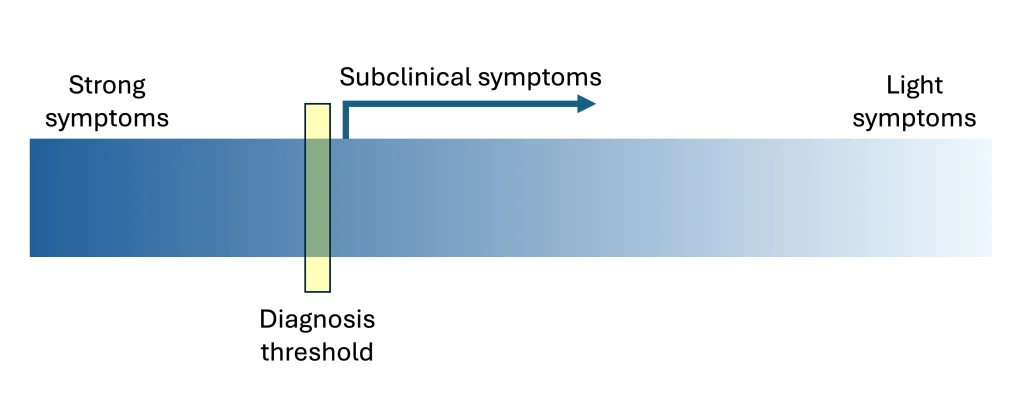
This is how this landscape looked in my mind:
There was one continuum from strong to light symptoms. Somewhere on that continuum would be a “diagnosis threshold”. If your symptoms were found to be on the “stronger” side of the threshold, you could get an Autism Spectrum Disorder diagnosis.
Your symptoms could also be on the “lighter” side of the threshold (“subclinical symptoms”), which meant you wouldn’t qualify for a diagnosis, but the traits could still affect your life.
Nice try, Tom.
I’ve let in now that reality is much more complex.
The autistic reality–a multidimensional spectrum.
I described the ICD-11 diagnostic requirements for Autism Spectrum Disorder in my article Am I autistic? #2 Well, what does it MEAN to be autistic.
However, while planning to describe the autism spectrum more multidimensionally, I didn’t feel comfortable with using the symptoms as described in ICD-11 as dimensions. I’ve already studied autism enough to not accept unconditionally labelling every autistic trait as a defect.
Instead, as examples for this article, I asked Google Gemini to compile a list of “well-known and fairly common autistic traits”. Needless to say, this is not an exhaustive list at all. I chose 14 of the traits the AI suggested for me:
A selection of fairly common autistic traits
I will use the exact descriptions Google Gemini suggested. My apologies if Google has used copyrighted material to train the AI for this answer.
Social and communication traits
These aren’t just about “not being social”; they are about using a different social “operating system.”
- Social scripting: Mentally rehearsing conversations before they happen or “playing back” interactions afterwards to check for errors.
- Directness over subtext: A strong preference for honest, literal communication. Finding hints, sarcasm, or “fluff” confusing or deceptive.
- Eye contact fatigue: Finding eye contact physically distracting or intense. Many autists look at a person’s mouth, nose, or the wall to better “process” the words being said.
- The “unwritten rule” gap: Feeling like everyone else was given a social manual at birth that you somehow missed.

Cognitive and sensory traits
This is how the brain filters the raw data of the world.
- Hyper-focus (monotropism): The ability to “tunnel” into a topic of interest for hours, losing track of time, hunger, or the environment.
- Sensory “allergies”: Being physically pained or agitated by specific textures (clothing tags, microfiber), sounds (clocks, humming fridges), or smells.
- Pattern recognition: Noticing a break in a sequence or a small error in a data set that others completely overlook.
- Need for predictability: Feeling a sense of “internal panic” when plans change at the last minute or when a routine is disrupted.
Physical and behavioural traits
These are the outward expressions of an internal state.
- Stimming (self-stimulatory behaviour): Repetitive movements used to regulate the nervous system—pacing, fidgeting, rocking, or even “verbal stims” (repeating a satisfying word).
- Executive dysfunction: Struggling with “simple” multi-step tasks like starting the dishes or organising a schedule, even if you are highly intelligent in complex areas.
- Object personification: Feeling a strange sense of empathy for inanimate objects (e.g., feeling bad for a “lonely” spoon left in the sink).
- Niche expertise (special interests): Having one or two topics that provide immense joy and act as a “battery” for your mental health.

The “internal” traits (the invisible side)
- Alexithymia: Difficulty identifying or naming your own emotions in the moment (often realising how you felt hours or days later).
- Delayed processing: Needing a few extra seconds to process a question or a command before the “data” clicks into place.
Let’s imagine an autistic trait pie
Now, let’s imagine that the chosen autistic traits are slices of a pie. Each slice is a spectrum in its own right, with light symptoms at the centre of the pie and strong symptoms around the edge.
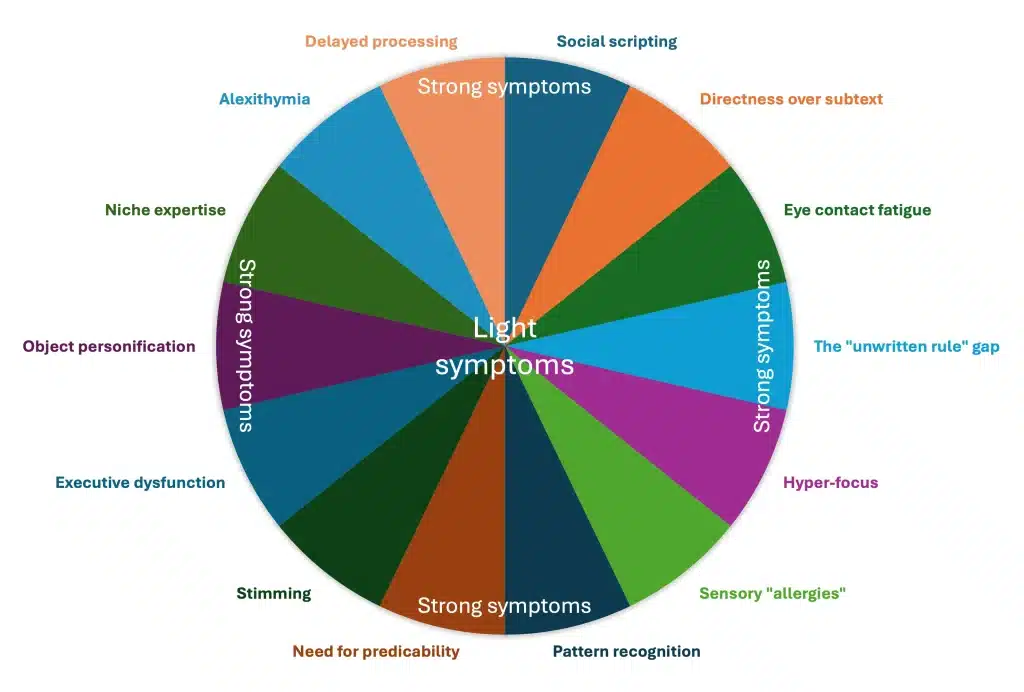
This is obviously a much more complex situation than I originally imagined the spectrum to be. So, to make it even more complex, let’s add this:
- A person can be anywhere on the spectrum of each individual trait (have more or less of each trait).
- A person may not have all of the chosen traits at all.
- I have chosen 14 traits for this example, but a person may have other traits associated with autism.
- A person’s position on the spectrum of each trait might change depending on the situation and over time.
From this new perspective, it’s plain to see that there must be millions of possible “autistic profiles” even based on this simplified illustration.
What do I mean by profiles?
Getting personal with the spectrum
As an experiment, I tried to roughly assess my own position on each of the pie slices:
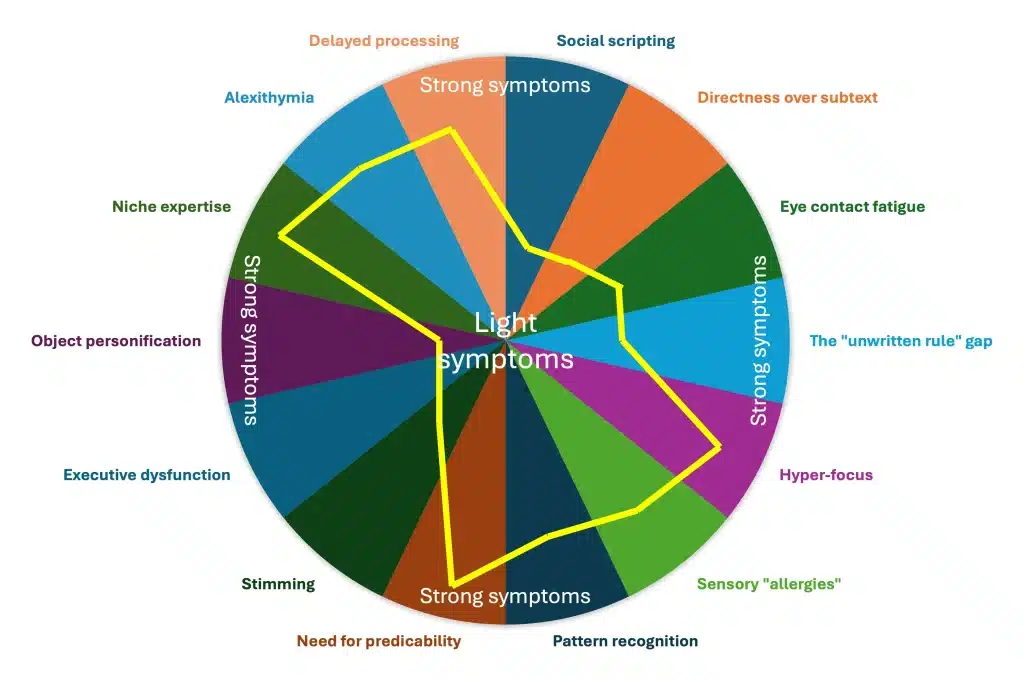
The yellow lines create a kind of personal profile for me on this “spectrum model”, though only based on gut feeling, not on any scientific research or metrics.
Variations over time
I claimed above that a person’s position on the multidimensional spectrum may change over time. This was based on what I’ve recently read in books written by autistic authors.
However, after doing this experiment, I’m ready to support this assumption. Thinking through my own “profile”, I’d like to mention just a few examples:
Fluctuations along with changing energy levels
My possible symptoms of alexithymia and delayed processing can definitely change from day to day, or even from hour to hour, depending on how tired and stressed I am.
And even though the capacity for speech wasn’t among the chosen traits in my illustrations, I’ve also experienced that high stress levels can impair my ability to express myself verbally quite noticeably.

Potentially suppressed symptoms
Although this is something I will explore later on this journey of self-discovery, I have clear memories of having stronger symptoms within several of the pie slices:
- Social scripting: I used to think of this as worrying and ruminating because of my social anxiety, but could it have started out as an autistic trait?
- Eye contact fatigue: Prolonged eye contact used to stress me immensely, but I actually remember deciding at some point I had to learn this.
- Stimming: I used to bounce my knees all the time; another thing I attributed to my anxiety levels. But I never thought of it as self-stimulation.
In my coming explorations, I believe it’s important for me to comprehend why I have milder symptoms in these areas now.
Because if I’m autistic, it’s possible this is because I’m masking, that is, I’m just hiding the symptoms, perhaps even from myself. And hiding isn’t the same as healing.
The possibility of improving from experience
Another thing I will also need to investigate further is the likelihood that if I’m autistic, some things may have become somewhat easier to handle as I gained knowledge and experience. Which could have mellowed the symptoms within a trait.
Take directness over subtext, for instance.
Yes, I strongly prefer honesty and clarity over hints and sarcasm in direct spoken communication with others. But I would say I’m quite good at spotting hints, sarcasm, and other linguistic acrobatics with ambiguous or double meanings.
In written communications, I even use tools like irony and sarcasm myself, perhaps more than I should. But I feel this is different. When you read, you have more time to think.
However, maybe all of this is something I’ve learned along the way? Perhaps the hard way, sometimes? I’ve always been a quick learner, so I might have picked up these skills quite early.
Summing up the spectrum
This (for me) new and multifaceted view of the autism spectrum has undoubtedly deepened my understanding of the subject. The spectrum I’m now envisioning is, in a way, wonderful and definitely fascinating, with its huge potential for diversity.
But important and serious themes that I’m eager to explore in future articles are also raised by this.
For instance, how people are generally talking about autism now seems ridiculously shallow and uninformed. For instance, “He’s so typically autistic!” What can a “typical autist” be in this multitude of possible variations?
Furthermore, it’s clear that obtaining a medical diagnosis, which may be of extreme importance for people who need support and adjustments in school and work life, must be entirely up to the discretion of the healthcare professionals assessing them. There just aren’t any hard metrics or thresholds to decide whether a person “is autistic” or not.
And finally, what can a medical diagnosis, or its absence, really say about how autistic lives are in all their diversity?
One thing is for sure: It must be true what I’ve heard autistic voices say repeatedly now:
“If you have met one autist…you’ve met one autist.”











Post Comment
You must be logged in to post a comment.