Stop saying “others have it worse”: Ending mental health shame
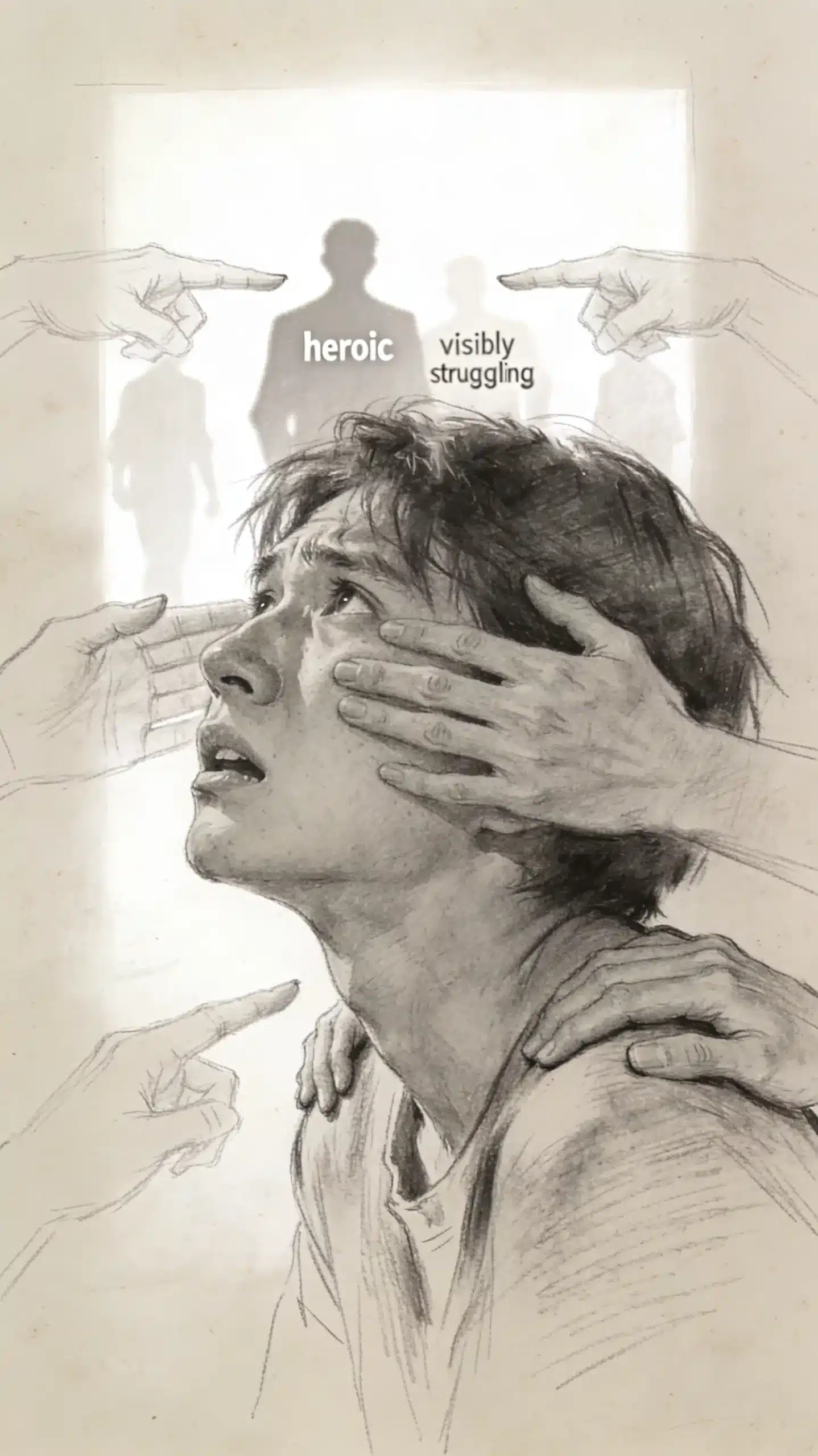
Have you ever been ashamed of your anxiety, depression, or other mental health challenges, because you have no reason to feel this way?
I’ve been there. Because, you know, others had experienced the most horrible things, and they were still coping well. So, how could I complain about anything at all?
I’ve written about mental health shame before. However, I think it’s time to shed some light on such a strange phenomenon: you are suffering, but you feel the need to add to the burden by being ashamed of your suffering, because you think you haven’t been harmed enough to justify it.
Strange indeed.
Comparison is meaningless if you don’t know what you’re comparing
First of all, there are many good reasons why you shouldn’t compare yourself to others in the first place.
If you say that someone else has had more horrific experiences than you but is still coping better, there are at least two possible errors there:
Experiences are always subjective
Regardless of what has objectively happened to you and the other person, you can’t know that their subjective experience was more harmful to them than yours was to you.
Let’s imagine that you recently lost your beloved grandmother and are really struggling to handle the grief. The other person was nearly killed in a terrorist attack, but was a trained and experienced police officer born with a personality not easily affected by stress.
How can you know which of you suffered the most harm?

The worst battles are fought inside
And how can you really know that the other person is coping better than you? Because they put on a happy face and go to work every day? Because they look calm and confident?
Many people are extremely good at hiding the battles they’re fighting inside.
That police officer I mentioned was perhaps raised to always be strong and regularly bullied as a child when showing any kind of weakness. A childhood like that teaches lessons hard to unlearn.
So, how do you know how well they’re managing?
What if trauma is more than you think it is?
Trauma is a commonly used term for the harm we suffer when something happens to us.
A widespread misunderstanding about psychological trauma is that it needs to be the result of something acute and potentially life-threatening, such as a terrorist attack, an act of war, or a violent assault.
While such situations obviously are highly traumatic, it’s a fact that constant exposure to stress over a long time can cause much of the same psychological damage. Even when the situations aren’t necessarily highly dramatic or life-threatening, seen from an objective point of view.
Psychological trauma redefined
Many trauma survivors end up with Post-Traumatic Stress Disorder (PTSD), a medical diagnosis that at least has a definition in the ICD-11 diagnostic framework.
However, it seems like a clear definition of the different variations of the term psychological trauma itself is still missing. This is one version that can work, just to put words on it, borrowed from RAI Counceling Servies in the USA:
Type I trauma
Type I trauma, also known as acute trauma, refers to intense psychological distress resulting from a single, isolated incident. This type of trauma typically occurs unexpectedly and is clearly defined, often involving a sudden, overwhelming event that an individual experiences as a direct threat to their safety or stability.
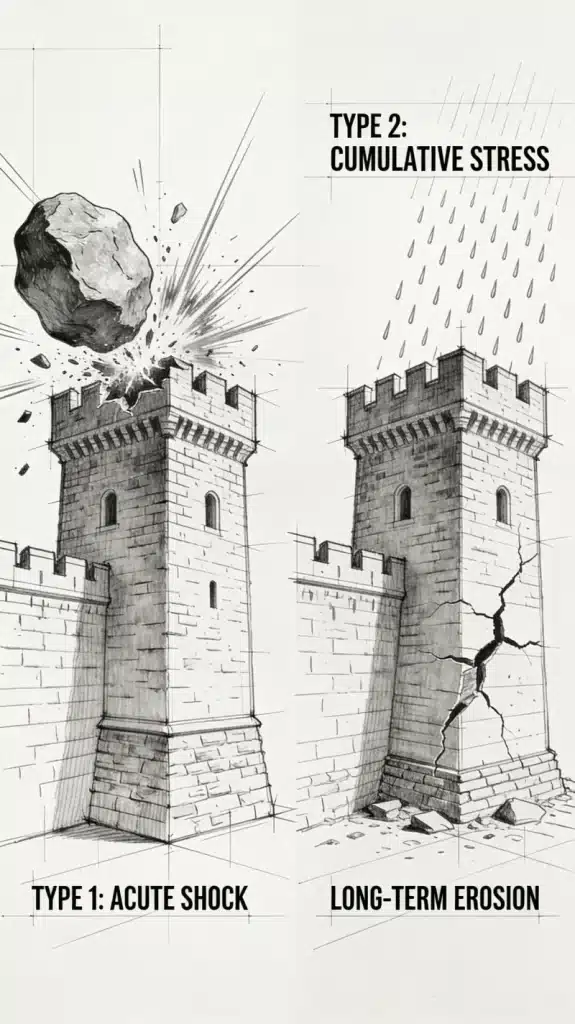
Type II trauma
Type II trauma, also known as complex trauma, arises from prolonged exposure to highly stressful situations. Unlike Type I trauma, which is linked to a single incident, Type II trauma involves continuous or repeated stress, such as enduring long-term abuse, chronic neglect, or living in a war-torn region.
Is Type I trauma worse than Type II?
Is one type of trauma worse than the other?
How can we tell? There are so many factors involved, and one person can suffer more than another from exactly the same incident.
True, most of us have mainly thought of Type 1 as the definition of psychological trauma and assumed that the intensity of an acute trauma just must make it worse than more low-level but long-lasting adversities.
However, is it necessarily so?
What if stress intensity isn’t the only thing to consider?
Let’s do a thought experiment.
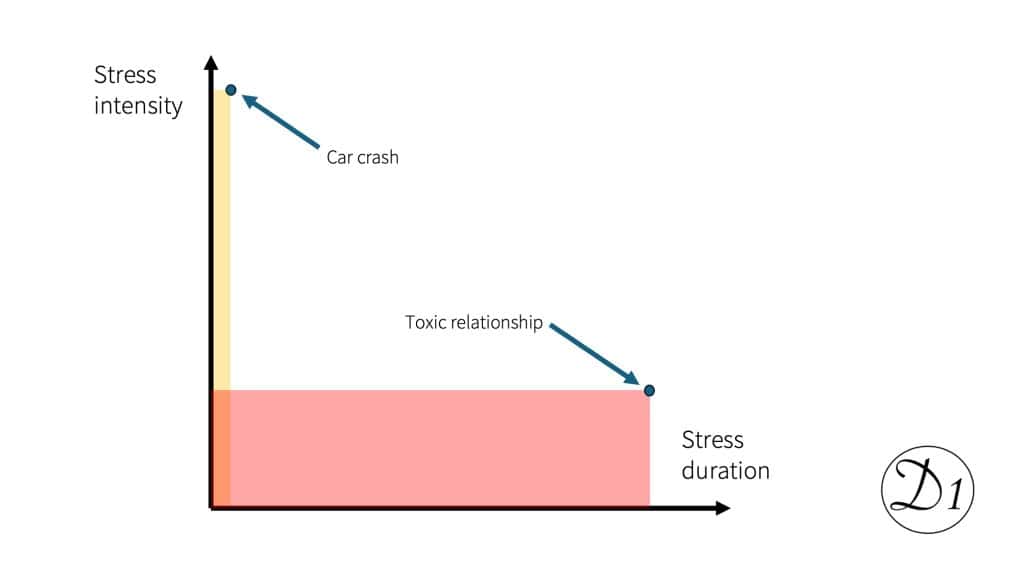
To eliminate personality differences, we can imagine one person experiencing two traumatic situations: A dramatic car accident and a long-lasting toxic relationship.
Even though it’s a simplification of real-life experiences, let’s look at only two properties of these situations: the stress intensity and the stress duration.
A shocking car accident would mean a sky-high stress intensity, but a relatively short stress duration. A decade-long toxic relationship would presumably not mean a comparable stress intensity at all, but the stress duration would be exceptional in comparison.
The illustration below shows the difference in possible stress accumulation, which may indicate the degree of inflicted trauma in the two situations.
There’s no such thing as “not deserving” to be harmed
For this particular person, in those two particular situations, the accumulated stress and potential trauma caused by the long and toxic relationship were worse than the harm from the traffic accident.
You are probably in a different situation, and if you had experienced the same situation as the imagined person above, your reaction might have been different–one way or another.
The point is, however, that you can’t say that you don’t “deserve” to feel traumatised because the situations you’ve been in weren’t acute, dramatic, or violent “enough”.

It’s not about what happened; it’s about what harm it caused
That’s true! What’s important is how your experiences made you feel and what impact they’ve had on your ability to live a meaningful and fulfilling life.
Even if someone you know wouldn’t be harmed by what you’ve experienced, it doesn’t mean you “ought not” to be harmed by it and don’t “deserve” to be affected by the damage.
But wait! Is there nothing that can (more or less) objectively determine whether people are psychologically harmed by situations they experience?
The harm caused by helplessness
Oh, there seems to be one thing:
Research has shown that the degree of psychological harm is deeply connected to how helpless you feel in the traumatic situation:
Being able to move and do something to protect oneself is a critical factor in determining whether or not a horrible experience will leave long-lasting scars.
– Kolk, Bessel van der. The Body Keeps the Score (p. 55).
This makes sense. You can feel desperately helpless both in an acute situation (such as a car crash or a violent assault) and in a long-lasting one (such as a toxic marriage or years of bullying at school).
And there’s one thing we need to remember:
Who are more helpless than children, regardless of whether the traumatic situation they experience is acute or long-lasting?

The effects of childhood trauma
In his book The Body Keeps the Score, Bessel van der Kolk refers to a study on Adverse Childhood Experiences, showing that:
- Traumatic life experiences during childhood and adolescence are far more common than expected.
- As the children matured, they didn’t “outgrow” the effects of their early experiences.
In this particular study, people were asked ten concrete groups of questions about adverse childhood experiences (ACEs):
Abuse (direct harm)
- Emotional abuse
- Physical abuse
- Sexual abuse
Neglect (lack of care)
- Emotional neglect
- Physical neglect
Household challenges
- Mother treated violently
- Household substance abuse
- Household mental illness or suicide
- Parental separation or divorce
- Incarcerated household member
This is far from an exhaustive list of adversities a child can experience, of course. The study was focused on domestic circumstances, so bullying at school, for instance, wasn’t included.
However, the study clearly showed that the long-term harm (trauma) rose exponentially for each additional type of ACEs the respondents had experienced.
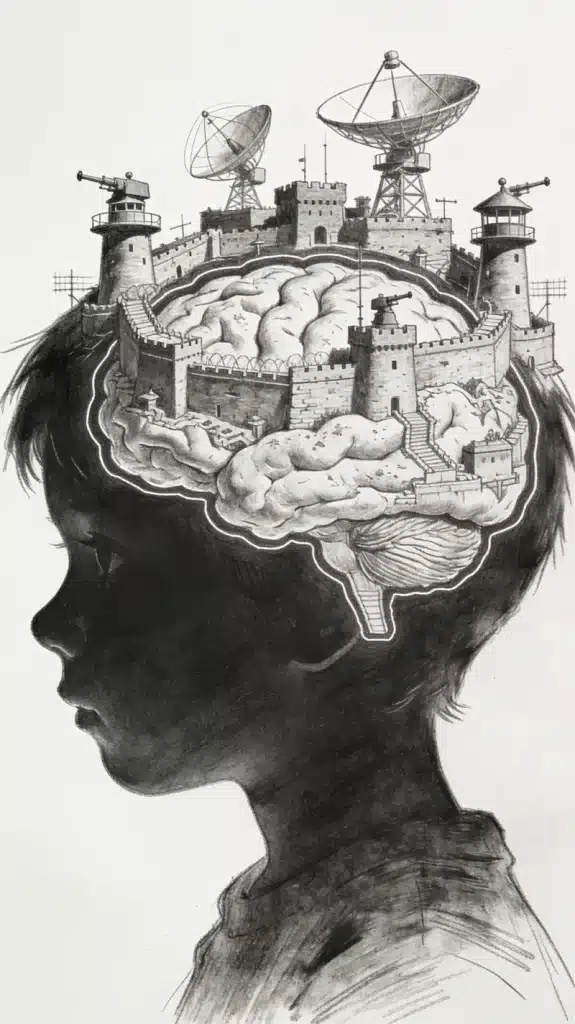
When the brain specialises in threat management
Adversities experienced in childhood may shape your brain and quality of life for the rest of your life.
If you feel safe and loved, your brain becomes specialized in exploration, play, and cooperation; if you are frightened and unwanted, it specializes in managing feelings of fear and abandonment.
– Kolk, Bessel van der. The Body Keeps the Score: Brain, Mind, and Body in the Healing of Trauma (p. 56).
When van der Kolk says your brain “specialises”, it actually means physical changes in the brain. Among other things, your amygdala (the brain’s alarm centre) might be constantly switched on, causing you to live in a constant, hypervigilant state. You may also be left with a constantly dysregulated stress response system, emotion regulation difficulties, and memory and concentration issues.
Reversible brain damage
In one sense, we can say that your stressful childhood experiences have caused you physical brain damage.
Luckily, this isn’t irreversible damage. The unfortunate wiring of your brain caused by early negative experiences can be rewired. I don’t promise it’s easy, nor that it can be done quickly. I just say it’s possible.
However, it’s only possible if you acknowledge and own your problem. And this is unattainable unless you stop thinking you don’t “deserve” to be harmed by what happened to you.
A traumatised self-esteem
What sometimes makes it more difficult to heal from Type II trauma compared to more acute experiences is the possible long-term effects they have on your self-esteem.
The core fear connected to Type I is often “I’m going to die!” and healing will largely be to process a singular event and come to understand that it is a singular event that happened in the past.
In contrast, suffering Type II trauma because of, for instance, long-term neglect and abuse, often in childhood, is frequently accompanied by permanently damaged self-esteem. The core fear might be “I am not acceptable/good enough/lovable”.
It’s no longer only about processing what someone did to you; it’s also about repairing who you think you are. It can be a lot of work to rebuild a ruined self-esteem.
So, starting now is recommended if this resonates with you.

Abandoning the shame is essential for your healing
Type I and Type II trauma aren’t definitions everyone uses. You may find expressions like ‘Big T’ versus ‘little t’ trauma. You might see acute trauma compared to cumulative trauma, shock trauma to developmental trauma, and so on.
They aren’t all necessarily completely synonymous with each other; slightly different meanings may be attached to them by different sources.
That doesn’t matter. This matters:
- You can be psychologically harmed both by sudden, shocking events and by long-term challenges that chronically exceed your ability to cope.
- There’s no way to say that one way to be traumatised is “worse” or “more harmful” than the other.
- If what happened to you prevents you from living a good and fulfilling life, then you are harmed by it, and you have no reason to feel ashamed of not being “harmed enough”.
- Not realising this will block your ability to acknowledge and own your problem and, therefore, block your healing.
Deliberate 1 is my independent channel for expression and creation.
At the time of writing this article, I have not asked for, been promised, or received payment, services, or any other compensation for mentioning other people’s products or points of view in the article.
This includes Bessel van der Kolk’s book The Body Keeps the Score.











Post Comment
You must be logged in to post a comment.