Am I autistic? #9 Lost in people’s hidden language

Sometime in 1993.
I hurried into the meeting room to brief the Health Services Leadership Team on something related to my role as the IT Consultant for one of the administrative districts of Trondheim City Council. As I stepped into the room, an Invisible Man punched me in the face.
I presume I need to explain this.
Of course, there was no Invisible Man in that meeting room. It just felt like I’d been punched by one. Why? Even though my memory tells me the air was thick as syrup, smelling of ozone and sulphur, knocking the air out of my lungs when I ran into it, I know it wasn’t physically like that.
Within a fragment of a second, I had scanned every person around the table, the expressions on every face, their postures, the way they held their hands, everything. Not a word had been spoken, but I immediately knew that something was about to explode.
Much of human communication is non-verbal. I should know. I have the most enormous, sensitive aerials for picking it up.
Sometimes, the signals from people around me scream in my mind like a deafening fire alarm, even if the room is dead quiet.
My problem isn’t seeing the signals. It’s understanding why they’re being sent.
Seeing what others don’t
It’s been a long-standing stereotype that autists don’t understand non-verbal communication, and neither can they use it appropriately.
I find this quite interesting to analyse, as part of my quest to understand whether I’m autistic or not. I suspect this topic calls for far more nuances than the old stereotypes allow.
If I’m autistic, having difficulties “receiving” the non-verbal signals is definitely not one of my traits. Heaven knows how much I wish I could shut them out sometimes.
And while I usually, and often involuntarily, can perceive even the subtlest non-verbal signal, I’m more and more prone to question how aware most people are of themselves sending them.
Being ignored without a word
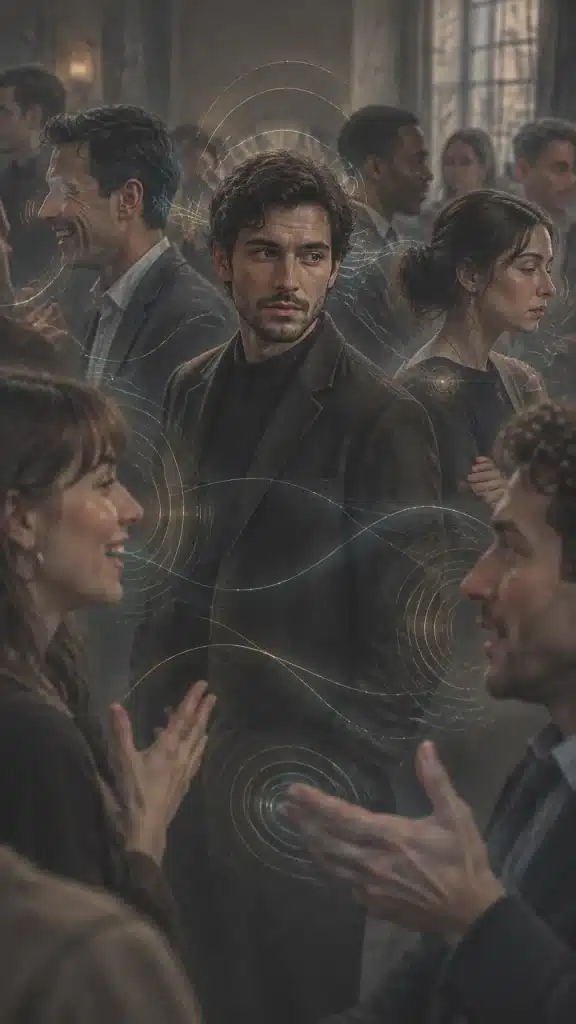
For instance, one of the most conspicuous cultural differences I noticed when I moved from Norway to the UK was how effortlessly people may ignore you until they have no choice but to acknowledge your presence.
They might disregard you entirely if you try to get past them in a narrow supermarket aisle or on a forest path, turning their back on you and continuing to talk amongst themselves, even though they obviously know you’re there.
For me, with my fine-tuned, non-verbal reception aerials, turning their back on someone like this is synonymous with shouting, with all-caps, bold, and italic letters that say, “I don’t care you’re here! You are not worth my attention! Get lost!”
Which I find extremely rude.
It’s not like my fellow Norwegians are particularly forthcoming towards strangers. Not at all. But it’s customary to at least recognise someone’s existence with brief eye contact or even a nod.
When neutrality isn’t neutral
This was a randomly chosen everyday example, but it makes me wonder: are most people just as unconscious about their non-verbal communication as they are with their verbal machine-gun conversations?
Let’s just let this question hang there for a little while.
In the meantime, it’s fair to ask whether I am any better at communicating non-verbally myself. I claim to be highly receptive, but can I express myself non-verbally?
That’s a relevant question. My first wife regularly complained about me having a “sour mouth”, which meant I didn’t display the amount of jolliness she expected from me. In most of those cases, I wasn’t in a particularly bad mood. More likely, I was deep in thought about something that wasn’t unpleasant, but it didn’t give me any reason to laugh, skip, and jump either.
From my perspective, I displayed what presumably was my version of a neutral facial expression. I didn’t intend to send any non-verbal signals, because I didn’t have anything to communicate at the moment. Just as I rarely speak verbally when I don’t have anything sensible to contribute, I may not send non-verbal signals for the same reason.
Still, from the outside, from the perspective of “normal” people, not sending signals is apparently often seen as weird, or perhaps scary, and more negative in itself than aimlessly, unconsciously, and continuously scattering signals around you (the machine-gun approach).
Which, for all I know, may be the real difference between an autistic and a “normal” communication style.
Eye contact isn’t as simple as it looks
However, we can’t leave my non-verbal communication “deficiencies” without discussing the flagship of old autism stereotypes: the inability to make eye contact.
I was about to write that this hasn’t been much of a problem for me. But then I remembered the exact moment when I discovered this was a big deal. I read it in a magazine.
I believe the article I read in the Norwegian magazine “Illustrert Vitenskap” (“Illustrated Science”) in the late 1980s was about the importance of body language if you wanted people to trust you. The article presented firm handshakes and eye contact as absolute musts.
Personally, I didn’t like handshakes at all, and I hadn’t thought much about eye contact before then.
Acknowledging my lack of knowledge, I followed the article’s advice. I started shaking hands firmly enough to make people wince sometimes, and I simulated eye contact by staring at a point between people’s eyes.
The latter felt really weird.

Looking away to listen better
And the weirdness of it shouldn’t be too strange.
I grew up around a lot of animals. For every animal species I’ve known, staring someone in the eyes is a threat, a provocation, an instrument of domination. Except for most humans, who have decided they can’t trust anyone who doesn’t make extended eye contact.
Is it meant to signal that we’re paying attention?
I don’t know. But for me, it isn’t necessarily so that I pay the best attention if I look at something or someone. Let’s say someone is speaking. I concentrate best when I can focus on the sound alone, so I’m best off looking at something neutral, like my hands. I mean, you can listen to music without staring at the guitarist, can’t you?
Perhaps this is about information processing. They say autistic brains process more information than “normal” brains, and maybe it’s sometimes necessary not to receive data from more than one channel at a time.
Anyway, I don’t think people found me more trustworthy than before when I started deliberately making eye contact. I hadn’t realised eye contact wasn’t something you either did or didn’t do. It needed a specific rhythm to pass as natural.
But we learn to adapt and adjust. We get better at masking over time, and making eye contact isn’t much of an ordeal for me now. But it is still an acquired skill, not a natural instinct for me.
Even smiling has rules
Another skill I’ve acquired is smiling in appropriate situations.
I smile naturally and spontaneously when I’m happy or amused. Traditionally, if I wasn’t happy or amused, I didn’t smile. I’m that simple, you know.
This was probably why my first wife was provoked by my “sour mouth”. I wasn’t unhappy or angry. But I didn’t put on a smile when I was expected to, according to some Code of Conduct apparently well known to everyone but me.
So, I learned to put that smile on in some situations. For instance, I tend to smile briefly when I make first eye contact with someone, across a range of situations from formal meetings to chance encounters with someone in a doorway. I feel this is a nice way to signal, “I have the best of intentions” and “I’m no threat to you”.
Most of the time, I believe this approach works. Back in Norway, I can’t remember anyone responding negatively. Here in the UK, I sometimes feel my unsolicited smiles make people slightly uncomfortable.
Apparently even smiling has unwritten rules.

Mirroring: the invisible handshake
One thing that probably has its own comprehensive chapter in that Code of Conduct is mirroring.
Mirroring is people instinctively copying each other’s non-verbal language, including gestures, facial expressions, and tone of voice. I’ve understood that this serves much the same function as what I intend (perhaps not always successfully) with my “welcome smiles”: “I’m here, I’m interested in what you may want to communicate, and I’m not dangerous.”
Me and mirroring? To be honest, I don’t think I do it much.
Except if I deliberately choose to. Which doesn’t mean I’m calculating or manipulative. It’s more that I sense something’s missing, that people expect something from me, and I choose to do it to avoid unnecessary friction.
And if I don’t? I acknowledge that there may be a communication gap right here. If other people need me to copy their behaviour to feel connection and interest, I’m probably not always meeting those expectations. It’s possible that I may be genuinely engaged and interested but still come across as cold and indifferent sometimes.
Invisible borders
Oh, I can think of another way I may seem cold and inapproachable.
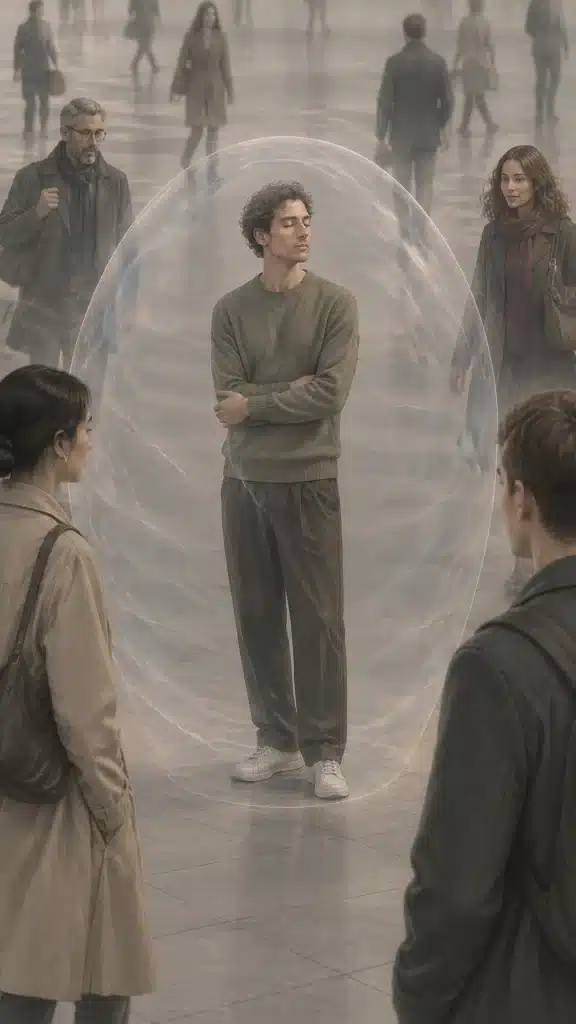
I really appreciate personal space.
Throughout my life, only one person has ever been able to cross my invisible borders without my nervous system immediately protesting: my present wife.
I don’t know if this indicates autistic traits, for instance, related to sensory sensitivity. Perhaps it’s learned, self-protection behaviour from my childhood. Maybe it’s just cultural baggage. No one ran around hugging each other where I grew up. You should consider yourself lucky if you got a hug from your mother after age five.
Most likely, it’s a combination of all of it. Handshakes? I understand this is the formal greeting we decided to use in the Western world. I can do it when necessary, even though I feel a Japanese-style bow would be both more respectful and less intrusive.
Hugs? That’s too intimate for me, unless you’re already among my closest.
Understanding the signal—but not the sender
Back in the meeting room in 1993, I quickly learned that the looming tension wasn’t about me at all. But I felt it like a punch in the face. Like I can feel everybody’s stress in a shopping mall before Christmas. It’s a physical pressure in my chest, even though I know it’s just my brain picking up and processing thousands of tiny signals from people’s body language.
Perhaps most people don’t realise how much they’re communicating. Every movement, every glance, every slight change in posture carries information.
I can’t seem to avoid noticing it.
It’s exhausting!
And just like I can understand what an engine failure indicator in a car is supposed to warn me about, I still won’t know much about why the engine fails. Have I done something wrong while driving?
I understand what a slightly narrowed eye might signal, a twitch at the corner of someone’s mouth, a body turned partly away. But I’m often clueless about why people send these signals. What are their intentions? What do they want from me? Have I done something wrong?
Understanding the signal is obviously not the same as understanding the person.
Whether I’m autistic or not, I’ve spent sixty years trying to learn a language that most other people seem to speak instinctively—but almost nobody consciously understands.
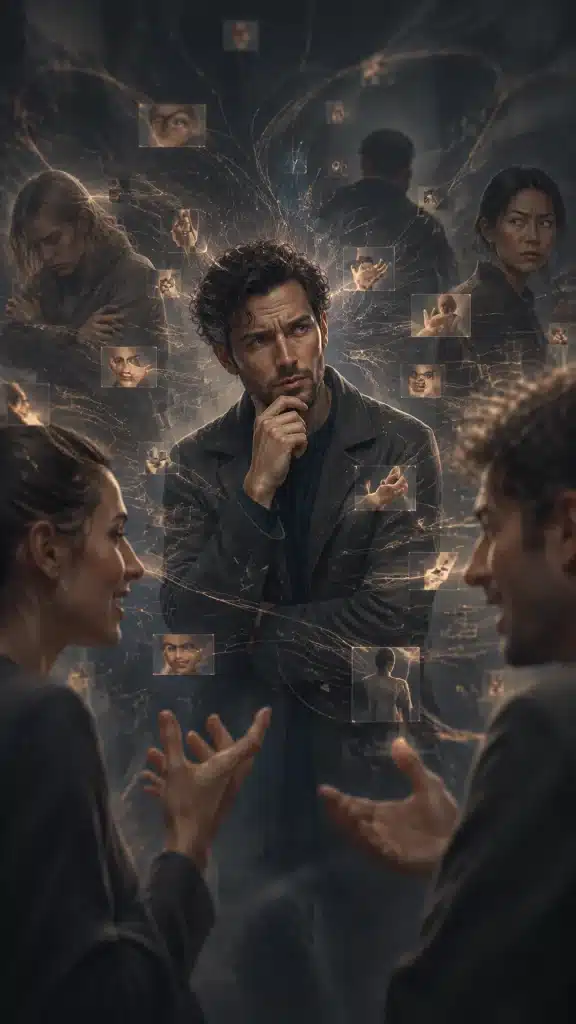
All pictures used in this article are AI-generated illustrations. One of them resemble me in my early thirties, but it’s not a real picture.
If you want to share this article with someone, feel free to use one of these sharing buttons:











Post Comment
You must be logged in to post a comment.