Am I autistic? #8 Lost in the swirl of verbal communication

I remember a situation a few months ago. I was about to leave the room when someone asked for my opinion on a topic the other four people were discussing. It was late, and I was already tired, but I sat back down and started explaining my views. Which wouldn’t have been easy under any circumstances, because it was a serious and complicated subject. In this particular situation, however, it was entirely impossible.
I don’t think more than five seconds went by without someone shouting questions, comments, and one-liners at me and each other. The whole conversation felt pointless to me, and I found the general behaviour rude and disrespectful.
Weeks later, I found a name for what had happened: a machine-gun conversation. There and then, I soon made my excuses and left.
This wasn’t the first time in my life I had “fled” from a conversation, exhausted and confused. It has happened hundreds of times, and I felt what happened wasn’t about exchanging information and points of view at all, but about something else entirely.
My problem is, I don’t know what that might be.
What are conversations really about?
What’s crystal clear is that people don’t always ask for your opinion because they’re interested. They are often impatient with a chain of reasoning. Sometimes, it seems they’re not even aiming to exchange information at all.
I’m not daft. I understand, of course, that what often seems to me like a chaotic, disorganised, and shallow table tennis with words actually has some kind of social function.
It’s likely about building trust, confirming group membership, maintaining relationships, negotiating hierarchies and status, and regulating emotions without resorting to violence. Things like that.
I’m perfectly willing to accept that this is important socially. What puzzles me is why these honourable purposes seem to require so much apparent disorder.
Human social communication is indeed a wide and complex topic. This article will focus on verbal communication. I will return later to look at non-verbal communication and the more intricate social aspects of communication.
When conversation follows different rules
The more I observe people talking, the more I suspect they often have entirely different ideas about what conversations are supposed to achieve. To be honest, I often feel many people just aren’t consciously aware of what they’re trying to achieve in their conversations. It all “just happens” as an instinctual response to the situation.
Perhaps I’m lacking this instinct? Or, to phrase it differently: perhaps I’m built to require a more conscious, orderly, and logical approach to communication?
I don’t think I’m the only one who finds most people’s communication style quite strange. Could it be that this is also one of the reasons why problems with social communication are one of the key signposts on the way to a medical diagnosis of autism, and also a major element in traditional, stereotypical views of autism?
On my personal quest to determine whether I might find myself somewhere within the broad landscape of the autism spectrum, social communication is precisely where my intuition tells me I should start looking.
Let’s break down my position across the different aspects of verbal communication.

Words should help us connect ideas, not scatter them.
The basic mechanics of language
I still remember the moment I cracked the code of reading. I must have been five years old, standing beside my mother’s washing machine. A Donald Duck magazine lay on top of it, and I was studying the speech bubbles.
Suddenly, something clicked in my brain.
My mother and sister had taught me the individual letters of the alphabet. And most likely, someone had read the magazine to me. I had probably memorised what Donald Duck and his nephews were saying.
So I just connected the dots–and could thereby read.
The mechanics of language, including grammar and vocabulary, have never been a problem for me. On the contrary, language mastery is probably one of my indisputable strengths.
For me, language is what brings knowledge and understanding and, therefore, is an instrument of order. It is a set of building blocks that could be used deliberately and systematically to build common understanding and connection.
Instead, it seems most people prefer to shake the box of building blocks, pour them out on the floor, and expect everyone to see meaning in the random pattern they land in.
Understanding language in context
A widespread, traditional view of autists is that they always interpret language very literally. This means they have difficulty understanding sarcasm, irony, idioms, teasing, and deliberate exaggeration.
It’s said that a question like “Can you open a window?” may be interpreted by an autist as “Do you know how to open a window?” rather than “I need you to open a window for me, please, because it’s quite hot in here?”
I can’t remember ever having significant problems understanding the message behind ambiguous language if I know the context.
It’s possible, of course, that I learned to look for and identify ambiguities at an early age. With my language skills and the general hypervigilance I developed in childhood for other reasons, I might have been able to compensate for any such problems.
As an adult, and as a writer, I sometimes deliberately choose ambiguous words and expressions myself to convey the exact meaning I’m after.
But this isn’t what usually happens in human verbal communication. Instead, many people seem to forget that a message isn’t communicated until it’s understood at the receiving end. They tend to think that as long as they know the meaning of what they’re saying, the listener must too.
This is often down to a sloppy attitude, and it’s not strange that many people struggle with understanding imprecise communication–whether they are autists or not.
The orchestration of conversations
According to old but still popular stereotypes, autists tend to interrupt others in conversations, forget about taking turns, and keep rambling on about what they themselves find interesting regardless of what others feel.
I don’t identify with this description at all.
For most of my life, my problem has been the opposite. I’ve been so afraid of intruding and interrupting that I’ve found it challenging to get into the flow of the conversation at all.
To the defence of autists (including, potentially, myself), I’d like to claim that the majority of people interrupt each other (and us) much more than we do. For example, as I described at the start of this article. It’s just that they have a mysterious verbal ping-pong way of doing it that they themselves don’t see as interruptions.
So why is it suddenly an interruption when we (whoever we are, the autists, the more thoughtful, or whatever) try to squeeze in a word?
I think it might be because our messages may arrive with a slight delay, which they can’t handle. I almost always think before I speak. I need to think before I speak. However, this doesn’t seem to be a common urge among most people. More often than not, they blurt out whatever comes to mind and think it through later. Maybe.
For me, this difference in how I approach discussions means that by the time I’ve thought things through and decided what to say, the conversation has usually already moved on to an entirely different place. I usually keep my mouth shut in these situations. But if I don’t, it’s probably seen as interrupting their ongoing verbal ping-pong game.

Switching gears in conversations
And that brings us to the constant skipping, jumping, and gear-shifting in conversations generally. People can shift between presenting facts, venting emotions, humour, planning, problem-solving, and more within a few seconds.
I can do all of this. Easily. But not within a few seconds. The constant flurry of changes in most conversations is mostly beyond me. Does this mean I’m slow?
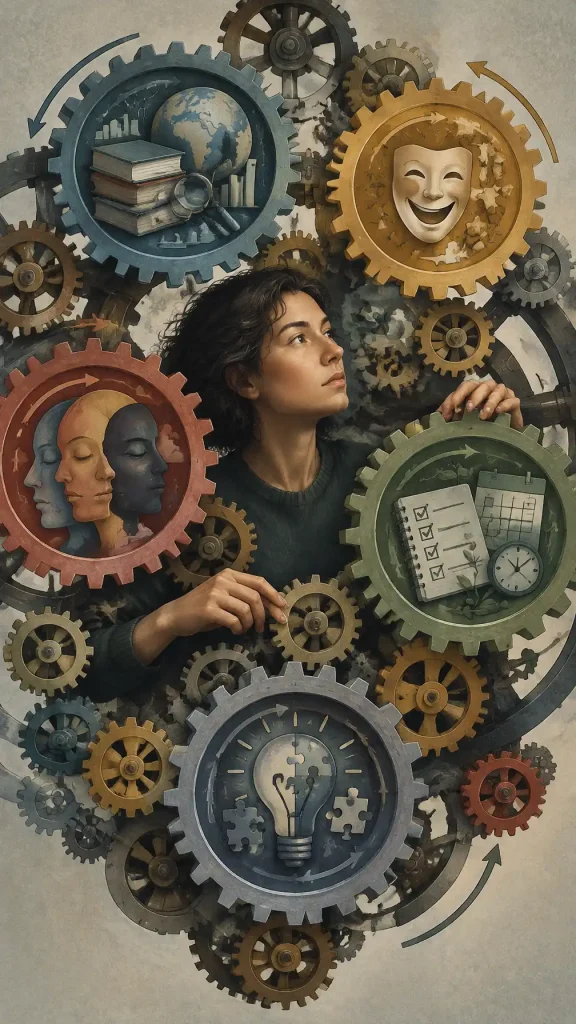
Perhaps. They say typical autistic brains have more neural connections within local areas than “normal” brains, and fewer between remote areas of the brain. Which I’ve seen has been used to explain why autists typically are very good at processing a lot of details, but may miss out on “the big picture”.
I don’t think that the absence of “big picture thinking” is a prominent weakness of mine. However, if it’s so that my brain absorbs and processes more details and data than most people’s, then a lot of my experiences through life, and most of my strengths and weaknesses, suddenly make sense.
And it’s also a plausible explanation for why I often feel I’m lagging a mile behind in conversations.
The management of topics
Closely related to the popular opinion that autists tend to dominate conversations by talking about their “special interests”, there is an assumption that autists have trouble introducing topics appropriately, staying on topic, recognising when others want to change the subject, and judging how much detail is appropriate.
Again, I struggle to identify with much of this.
I don’t think I’ve ever dominated conversations significantly, apart from in professional matters. On the contrary, if I don’t find the topic discussed interesting, I tend to “zone out” and not participate at all. There’s always a lot going on in my head, and I easily retreat there if what’s happening outside feels too boring.
However, if someone wants my opinion or asks me to explain something, I apparently sometimes stretch people’s attention spans a little. This might, of course, be why they start throwing unnecessary comments, questions, and jokes around. Or, perhaps that’s what they always do.
The problem is that some explanations do require an attention span longer than five seconds, which seems to be the absolute limit for many people I’ve met.
Unusual communication styles
Autists are generally believed to communicate in unusual ways. This may, for instance, be about speaking in a specific way, including with a rhythm that’s considered strange, monotonous intonation, and speaking either too quickly or too slowly, too loudly or too softly.
It can also be about having an unusual vocabulary, for instance, one too advanced for your age if you’re a child, or sounding too formal for the circumstances.
I had to ask my wife about this, and she hadn’t noticed anything strange about how I spoke. Except, of course, that I, as a late-in-life immigrant to the UK, have a somewhat peculiar accent in the first place.
Still, the thought of overly formal speech brought back a memory. I recall that, in my teenage years and early twenties, I sometimes felt uncomfortable with how I spoke. I was tired of it, honestly. What came out of my mouth often felt unnatural or, in a way, stiff and constructed.
I believe this happened because I felt the need to always be precise in what I said, to choose exactly the right words. Perhaps it was an autistic trait of sorts. Maybe it was just an old self-protection strategy.
Whatever the reason, it’s not a practical problem for me now. Why not? Well, we learn to adapt, don’t we? It might be a matter of masking.
Two-way transactions
Of course, conversations aren’t only about exchanging information. It’s also about giving and receiving the gift of attention.
I’ve read somewhere that autists may have problems showing curiosity for the other party, including asking questions and inviting questions to be asked. I also read that this might happen because the autistic person is too busy concentrating on what has already been said.
This may be true, in some sense, for me. I think I sometimes fail to show the expected curiosity for others because I’m busy processing everything going on, including what’s been said.
But the most important reason for what may appear as a lack of interest is that I don’t find it appropriate to bombard people with questions if I don’t know them well. I’m not too comfortable with that kind of bombardment myself, and I feel it’s intrusive to do the same to others, even if I’m genuinely interested.
But I’m afraid there is another reason. To be honest, I’m not always overly interested in everything other people do, and I can’t bring myself to fake it.
I’m sorry if this sounds arrogant. I am interested in a vast array of things, but not vast enough, for instance, to ask about the details of a work colleague’s recent trip to Blackpool, the reality show cousin Tina watched on TV last week, or Uncle John’s opinions about the state of the Premier League.
The big problem of small talk
This introduces the topic of small talk.
A skill that never has come naturally to me, and probably never will.
Sure, I’ve lived among humans for more than sixty years, and of course I understand that small talk serves an important function for most of them.
And that’s entirely okay.
Well, I’ll confess I struggle to understand how most people can keep going and going for hours, talking exclusively about things that seem entirely insignificant to me. However, it’s clearly none of my business what people choose to spend their time on.
Personally, I could have liked to warmly recommend, with the best of intentions, that they divert some of this time to quiet reflection instead, which seems grossly underrated among most people. But I respect that this is not everyone’s preference.
But what really puzzles me is why so many people quickly find me, and perhaps you, weird and alien if you don’t feel like participating in what we experience as idle, shallow, and meaningless talking.
Honestly, that’s really beyond me.
The exponential complexity of groups
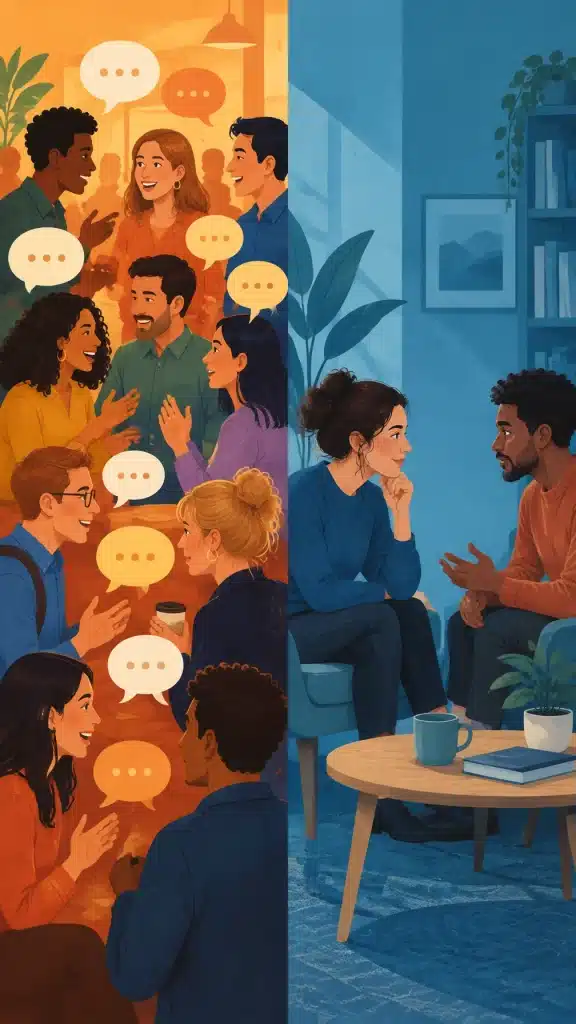
None of the problems I’ve admitted to so far would usually come up in a 1-to-1 conversation about serious, important, or even just interesting subjects.
Not even if my conversation partner has a different communication style than me, because most people focus and behave better when they’re not in a pack of peers who are exactly like them.
However, the larger the group, the bigger my problems become.
This may come down to information-processing challenges. The more people participating, the more data my brain tries to churn through. And it feels like this rises exponentially with the group size.
But there’s more to it. As groups grow larger, things soon start happening that seem rather bizarre to me, including competitiveness, hierarchy-building, and often bullying concealed as humorous banter. I’ll look at this in a later article.

When the world becomes too loud
Another thing that always changes as group size increases is the noise level in the room.
This has always caused me serious problems when trying to have conversations in pubs, cafés, work events, or other places where the buzz of people talking and other background noise effectively blocked what I needed to hear.
This was one of several things that inspired me to get hearing aids last year. While the hearing aids helped a lot in other circumstances, for instance, to hear what was said at the other end of the table in big meeting rooms, they almost made things even worse in noisy environments.
This makes sense if it’s true that my brain absorbs and processes more information than other people’s brains.
I basically get entirely overloaded when I, for instance, in a pub, hear thirty simultaneous conversations, three screaming children, plus football game commentators from five flashing screens on the wall, and people shouting at the top of their voices to encourage a football team that, in reality, plays 100 miles away.
On top of this, I see twenty people moving around in the pub, a visually blazing lighthouse of a gambling machine in the corner, and people constantly walking past outside on the street–and I’m still trying to participate in a conversation!
Usually without much success, until I entirely give up and zone out.
And, incomprehensibly to me, most people don’t seem to be affected by this sensory mayhem at all…
Different, not defective
So, do I have problems with verbal communication?
I’d like to say no, because in a 1-to-1 conversation or in a small group of well-behaved people, there are no problems. I can understand the nuances of spoken language, perhaps better than most people. And I can express myself precisely and use all the shades and facets of language.
My “problems” start only when communication isn’t really about exchanging information or a mutual attempt to understand the subject or each other. In most people’s communication, things are happening that I cannot fully connect with.
Are we talking about a lack of ability? Perhaps, to some degree. Mostly due to sensory overload in situations with many people, high noise levels, and chaotic communication.
But it’s also about preference. I prefer depth over breadth, substance over insignificance, and respectful, mutually illuminating information exchange over relatively aimless, randomly scattered words.
I think the label I invented, machine-gun conversations, is quite descriptive of people firing words around them, without aiming, without a thought for where and how they hit.
There is also a word for what I prefer: cooperative communication. Which means we are genuinely trying to understand something together.
And, to be honest, I don’t see any point at all in the opposite, the machine-gun type!

Does this indicate I’m autistic?
Well, if this indicates I’m autistic, that’s okay with me. Furthermore, I’ll be a proud autist if wanting and needing cooperative communication is a “symptom”.
I won’t judge those who enjoy Gatling-gun word exchanges, by all means. As I said, their preferences are none of my business.
However, there appears to be a real communication gap. I don’t understand machine-gun conversations. Others don’t seem to understand why anyone should choose not to join in.
The difference is that only one side is usually expected to adapt, while only the other generally feels entitled to judge.
All pictures used in this article are AI-generated illustrations.
If you want to share this article with someone, feel free to use one of the sharing buttons:











Post Comment
You must be logged in to post a comment.