Living in denial for 40 Years: Anxiety, depression, and a personal journey toward truth
If you’re suffering from anxiety and depression, you can’t start your healing process before you’ve acknowledged your problem. I’ve written about this in my article Anxiety and depression: Get out of the denial quagmire.
You can’t solve a problem if you don’t admit it exists.
Still, for 40 years, I refused to admit it.
This is a personal account about living a lifetime in denial in so many ways. It’s a story about slowly peeling off layer by layer of self-deception to arrive at clarity.
And, as I see it, it’s a story about persistence and hope.
Breaking the delusion of a normal mental state – 2005
It was dark and bitterly cold, sometime in late 2004 or early 2005, when I went for a walk to clear my head. I had reached a breaking point.
As I trudged along a slushy Norwegian footpath, I made a decision: the next morning, I would call my GP, ask for an emergency appointment, request sick leave, and accept whatever treatment she suggested.
This may sound simple, but it wasn’t.
For me, this was the moment the walls of denial finally cracked — and the shame and fear were almost unbearable.
The alternative, however, was worse. I could no longer see a future unless I did something drastic. No future at all.

When anxiety was simply “normal”
I had lived with anxiety for as long as I could remember. When the anxiety became too overwhelming for too long, I descended into periods of depression. This was my normal. I didn’t know life could be any different.
Today, many people speak more openly about mental health. Some may even casually refer to “anxiety” and “depression” to describe quite ordinary stress and sadness.
But the culture I grew up in was nothing like that.
When a relative of mine was bedridden for months in the late 1970s, my mother whispered — yes, whispered — her explanation:
“It’s the nerves.”
Back then, having “nerves” was considered shameful, weak, and almost morally questionable. In this rural, macho culture, some people would rather have had a syphilis diagnosis.
The first confession–and a warning to stay silent
About a year after that cold walk and my subsequent GP appointment, I finally told a friend about my shameful condition. We had been drinking, and after far too many drinks, I gathered the courage:
“I’m crazy, you know. I’m taking pills for depression.”
He didn’t laugh. He didn’t dismiss me. He simply said:
“I’d keep that to myself if I were you.”
He wasn’t being cruel — he was trying to protect me. As my friend, he believed openness would only expose me to judgment and more pain.
The many faces of denial
Among all the good and delusional reasons your mind may use to stay in denial, the fear of social judgment is one of the strongest.
But it’s not the only one. And my denial of suffering from anxiety and depression wasn’t my only refusal of reality. It took me decades to untangle it.
I promise you, the way out of the denial quagmire may be a demanding journey, but it’s an absolutely necessary prerequisite for any path of healing.
Shattering the delusion of what a normal relationship is – 2020
While fear of social judgment made it extremely hard to admit the truth about my mental state, there was another reason why it took me so long to understand I needed to take action:
I had never experienced anything else.
In particular, I couldn’t remember a life without anxiety. And this is tightly interwoven with my next denial of the truth: the delusion of what a normal relationship between people should be.
Learning to walk on eggshells before I could walk
My first memory that can be exactly dated is my paternal grandmother’s death in February 1969, a few days after my 4th birthday. There are other memories that may be older.
Even in my earliest recollections, there is always this element of insecurity and fear.
I believe I learned to walk on eggshells before I took my first steps, never knowing what would happen next. Always fearing that what I did, or what others did, would make a new bout of conflict, anger, or bullying erupt.
I know now that I spent my childhood in a toxic, dysfunctional environment. But back then, to me, this was “normal”, and I didn’t know any alternatives.

When dysfunction looks like everyday life
Didn’t I understand that it wasn’t really normal? I don’t think so. Of course, I read about families treating each other differently. And TV programmes I watched also sometimes showed loving, supportive families. For me, this was fiction. Something to covet, perhaps, but not something to expect.
Of course, I met people who treated each other nicely, who even treated me nicely. But this didn’t mean much. As I knew so well, the facade and what went on behind it could be two completely different things.
Marrying fear instead of love
In 1985, one year after I moved away from home, I entered my first long-term relationship. It was also a long-distance relationship for most of the first years, as I was away for my studies and National Service.
We didn’t get any experience being a full-time couple until 1989, when we moved in together. That’s when I started walking on eggshells again. Once more, it seemed completely unpredictable to me what reactions any of my words or actions could trigger.
As a result, in 1993, I married a person I already feared more than loved. And I stayed in this relationship for almost 36 years from the day we met till the day I left. It took me 35 of those years before I even asked myself, “Can this be right?”
Why?
How denial protects and diminishes
Yes, why? That’s a good question!
However, tiptoeing around, always trying to avoid conflict, judgment, sarcasm, and bullying was what I’d done all my childhood and youth. For me, this was how I expected a normal relationship between people would be.
But come on, a full-grown man, relatively intelligent, well educated, and physically strong! How can such a person be so submissive, a backseat passenger in his own life?
It’s kind of pathetic, isn’t it?
It wasn’t, but that’s what I thought. This was probably another reason why it was so alluring to stay in denial.
Therapy without the whole truth
Or so deep in denial.
40 years old, in 2005, after I finally decided to acknowledge my anxiety and depression problems, I found myself referred to therapy.
Being reasonably acquainted with the history of psychoanalysis, I (rightfully) assumed there was a lot in my childhood to work on. And I did.
I believe my therapist, an old, experienced psychiatrist, sensed there was a big piece missing. I can remember her gentle probing.
However, in the therapy sessions, I never ever touched on my then-marriage. I blankly rejected any questions implying problems in this arena.
At that time, I was too scared to even discuss it. I never dared to even contemplate any changes in my life. Subconsciously, I knew that this Pandora’s box could never be shut again if once opened.
The terror of imagining a different life
Changes are often scary, but even more so if we don’t know what lies on the other side.
I had two children under 12 to think about at the time.
Furthermore, most of the extended families on both sides would think that if something was wrong with my marriage, it must have been my fault. I was the slightly strange, introverted one, and I had never complained to anyone about the relationship.
But I didn’t need them to judge me. With my disastrous self-esteem, I thought exactly the same myself.
And if I had dared to think about leaving, where could I have gone? As far as I could understand, no one else would ever tolerate, let alone love, someone like me. I was lucky my then-wife put up with me!
Better suppress it all and–not live happily, not live at all, but continue existing in denial.
When Pandora’s box finally erupted
Until my denial bubble burst with explosive force 15 years later.
Pandora’s box wasn’t opened by me excavating my then-marriage in therapy. It was inadvertently blasted open as a side effect of a totally different conversation.
The conversation, in this case, was simple, online messaging on a peer support app for people with various challenges in their lives. The conversation partner was a person in a different country, 700 miles away across the North Sea. I didn’t even know her name at the start.
Neither of us was there in search of any kind of relationship. But both of us desperately needed someone to talk to.
A connection that shifted the axis of my world
The connection was immediate. It turned out that both of us had very similar backgrounds and life experiences. The probability that two people so alike, living so far apart, should find each other is virtually zero. Still, we did.
This miracle, however, was not the one thing that entirely changed my worldview.
It was the difference between these conversations, this connection, and any other relationship I’d had with a human being my whole life. The contrast was so stark that the universe, or at least my universe, shifted on its foundations.

Discovering what emotional safety feels like
Imagine that I could talk to someone without fearing the consequences. Imagine saying what I had on my mind with no risk of raising anger, contempt, or sarcasm.
I hadn’t believed it was possible.
Also, to say whatever I thought and felt, and to be immediately understood. To such a degree that we often could predict what the conversation partner would say next.
For someone who had never felt completely safe with another person before, this was a revolution that left everything known until then flooded with a piercing, new light–altered, strange, almost unrecognisable.
It was then I started to remember and understand, and all my delusions about my first marriage evaporated.
The moment I stopped taking all the blame
There’s no doubt, I have my fair share of flaws, quirks, and peculiarities. But I couldn’t accept anymore that everything that had ever gone wrong in that relationship had been my fault.
Neither could I accept the imbalance in the relationship, the absence of my voice in every major decision, the eternal fear of saying or doing something wrong, the social isolation, the fear and humiliation. It hadn’t been right!
I wanted to know why. I wanted to hear her reasons for treating me the way she had. I wanted it to make sense, in one way or another.
We had several agonising conversations, but she couldn’t give me any form of explanation, nothing I could try to understand at all.
Seen from my perspective, this was a tortured relationship that irrevocably died during these conversations.
From collapse to courage
The world as I knew it, built on fear and denial, fell apart. I found myself in the middle of one of the most distressing periods of my life. The only thing that kept me sane, the only place where I felt safe, was in communication with my online friend. I had started calling her my friend from day one or two, then my sister.
For the first time in my life, I felt accepted without conditions.
I realised this meant someone could find me likeable.
Perhaps even lovable?
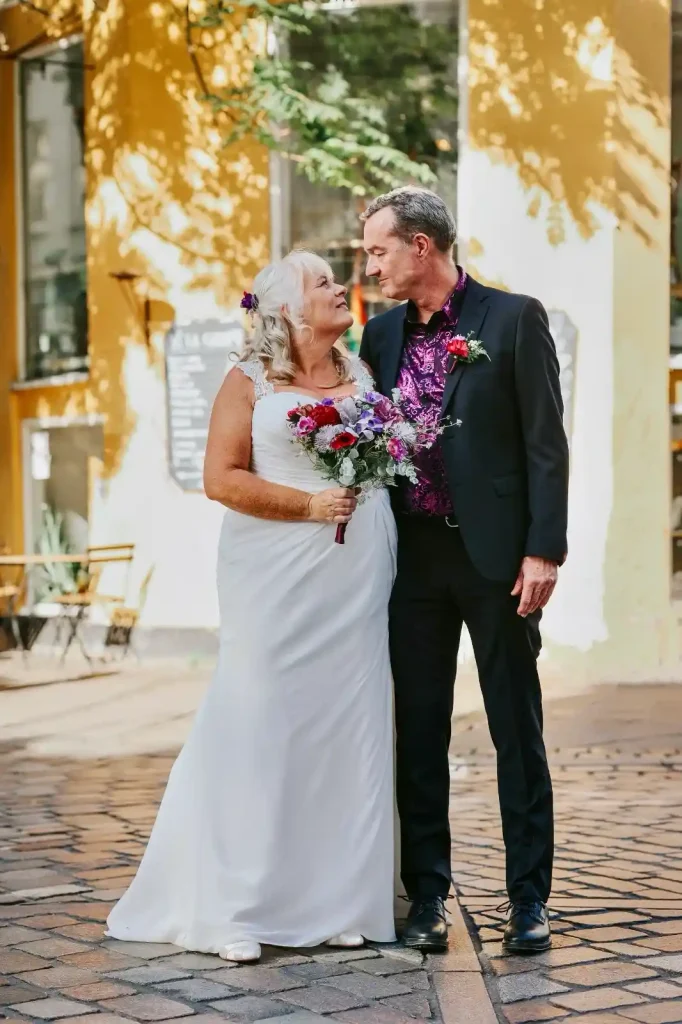
14 months after we had started communicating incidentally, with enough Covid jabs behind me to travel without quarantining and formally separated from my first wife, I flew to England to meet this special person in real life.
The rest is history, as they say.
We’ve been married for three and a half years as I write this.
Dismantling the delusion of needing to be useful – 2026
The tyranny of always being useful
Denial of reality is a normal psychological defence mechanism, which may help us avoid being overwhelmed by stress and anxiety. While sometimes helpful in critical situations, it’s an effective blocker of personal development and healing.
As I’ve described in my article The importance of doing something “pointless”: A personal account, I developed a habit of always striving for perfection and never wasting time on things that weren’t useful.
I subconsciously denied that it was good enough to be who I was without continuously achieving something. I rejected the idea that it was good enough to just sometimes be.
Realising the war was over
A few weeks ago, in January 2026, I finally realised this delusion of mine. Even though I had left my old life behind and established a new one with a true soulmate who has never given me any reason to believe I wasn’t good enough.
What a revelation! And a good reminder that even when the environment has changed completely, and the threats and battles of the past are long gone, the mind doesn’t automatically accept that the war is over.
It started as a survival strategy, for sure: the idea of always striving to do only things with a measurable, hopefully useful outcome, to always try to achieve something. However, the voice inside me that always pushed me on and on had ended up being a self-fuelled source of stress and a threat to my health.
Until, at the age of 60, I eventually understood that it wasn’t even my own voice, and had never been.
Peeling away denial, one layer at a time–an act of hope
Maybe it’s a lifelong project to remove not only the layers of denial but also the other psychological defence mechanisms and survival strategies we have learned, particularly if we began our lives on a rough patch.
I’m thinking that’s okay.
I don’t mean it’s okay that our situation compelled us to need defence mechanisms and survival strategies. However, as this has happened, it’s okay that it’s possible to see through the veils of self-deception, even if we’re not spring chickens anymore, and do something about it.
If we stay courageous and willing to act deliberately, there are always things we can do.
Acknowledging the truth is the first real act of hope.
So, get out of the denial quagmire!
All pictures used in this article, except the wedding picture of my wife and me, are AI-generated illustrations. They resemble me at various ages, but they are not real pictures.











Post Comment
You must be logged in to post a comment.