Mental health: The importance of doing something “pointless”

If you are a driven, solution-oriented person, this article is written for you and your mental health. I know from personal experience that for people like us, even rest and recovery easily become another performance.
If this rings a bell, please read on. I will argue that deliberately doing things with no measurable outcome is sometimes a psychological necessity.
I will use the word “pointless” about such activities, but not in a negative way. By “pointless”, I mean merely that the activities are done with no specific goals, no metrics to measure, and with no intention of achieving anything.
Understanding pointlessness
Pointless, in this context, doesn’t mean useless or wasted time.
I’m often promoting action in the articles on this website. I’m frequently emphasising that there is something that can be done in almost every situation. I’m urging people to do something about it if they have a problem.
It’s essential to understand that the deliberately pointless activities I write about now don’t contradict what I’ve said about direct, purposeful action. They are a necessary complement.
Why it’s important to do pointless things
Action with purpose is necessary for change. Most change is also challenging, often draining, and we need time for restoration, reconnection, reflection, and rest between the “battles”.
Some people, including me and perhaps you, aren’t good at resting at all. We tend to stay in “battle mode” (“fight or flight mode”), even when there are no external stress factors, even when we do things we love, because we always put pressure on ourselves to do more, to do it better, to be productive.
This is why some of us sometimes must make the deliberate decision to do pointless things.

How can you find something ‘pointless’ to do?
I think it’s more about your mindset and attitude toward what you’re doing than the specific activity itself.
Let me give you an example:
Many years ago, I wrote a novel. In hindsight, I believe I did it to prove to someone, perhaps myself, that I actually could write a novel and get it published. In this way, I put a lot of pressure on myself, which diminished the joy of creating, and it felt like a failure when the book wasn’t published.
If I, on the other hand, had written just for the fun of it, to enjoy the process, it wouldn’t have mattered if the manuscript was ever published. It would have been pointless, but great fun.
What’s important for you is to find something that’s interesting and engaging enough for you to maintain your attention and, ideally, put you in ‘the flow’, but not so challenging that it creates any kind of pressure.
Examples of (my own) pointless activities
I’ve recently decided to regularly make room for ‘pointless’ activities like these:
- Quiet reflection
- Focused observation outwards (just watching what’s happening around me)
- Focused observation inwards (this is what they called mindfulness)
- Focused reading (just for the experience, and no analysing while reading!)
- Focused conversations (being fully present while having meaningful conversations with people)
- Listening to music (I mean really listening, not just having it as a sonic backdrop)
- Playing my guitar and singing old songs
- Drawing (and I have absolutely no talent, so this is guaranteed to be ‘pointless’)
The common denominator is sustained attention without evaluation. And this is what you must look for as well, even though what’s perfect, pointless activities for you may be totally different from mine.
Why do some of us fear and loathe pointlessness?
For many of us, “wasted time” feels like moral failure.
While being a driven, solution-seeking person is beneficial in itself, many of us are primarily motivated by the belief that our self-worth is only determined by what we do, rather than who we are.
I write about how I came to this conclusion, or delusion, in this article:
This fear may also cloud our view of other people
I must admit, I’ve often looked down on people who spend much of their time watching football matches, cross-country skiing competitions (which are a matter of national identity in my country of birth, Norway), or reality series on TV.
I’ve come to understand that even though these activities feel like a total waste of time for me, they may be pointless in a positive sense for others.
What’s important here is quantity and intention. What’s good as a break isn’t necessarily good as a nearly full-time occupation. And a conscious decision to rest and restore isn’t the same as numbing ourselves with passive consumption of entertainment.
Why ‘pointlessness’ is extremely relevant in our era
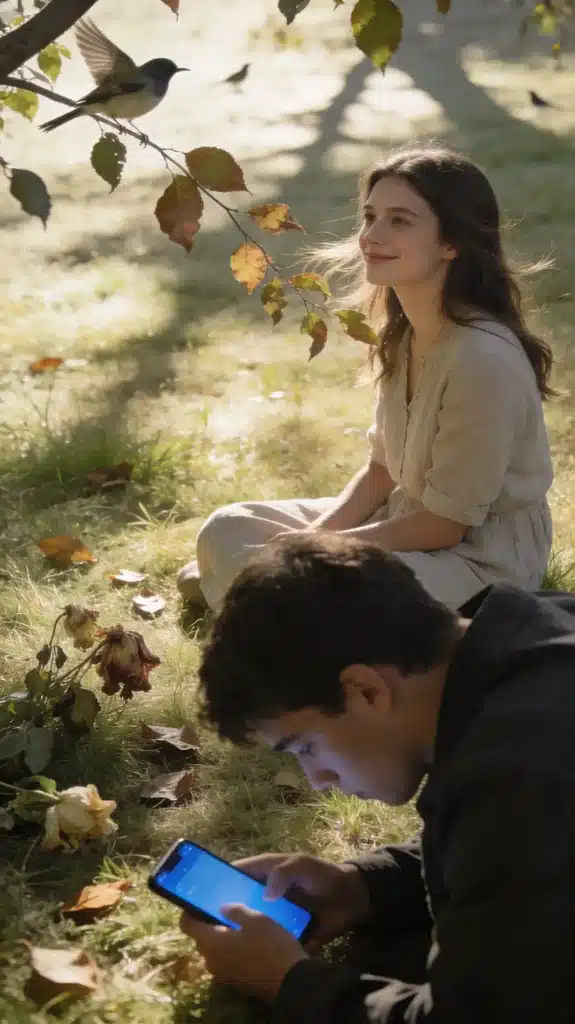
Passive consumption is the avoidance of reality.
Pointless activities are chosen, deliberate presence while recharging for the next dose of reality.
It’s crucial to recognise this contrast in an age when entertainment is always just an arm’s length away via laptops, smartphones, smart TVs, and even smartwatches.
It’s particularly essential for driven people like me and perhaps you to understand that while phones and laptops make it possible to do something “useful” at all times, this doesn’t mean we always should.
We need to just sit and look into the fire sometimes
For thousands of years, humans spent a considerable amount of time sitting around the campfire, watching the flames, sharing stories, worries, and ideas with their fellow tribe members.
This really was a time for restoration, reconnection, reflection, and rest.
In our high-speed, 24/7 world, moments like these must be deliberately chosen and created. Because we need time off from rushing around doing and achieving, especially if we’re good at always flogging ourselves forward.
Sometimes, we need time to just be.
If we spend all our lives achieving, we may forget how to live.

All pictures used in this article are AI-generated illustrations.











Post Comment
You must be logged in to post a comment.