The flip-the-coin trick: A “discover your strengths” appendix

I don’t know how many times I’ve sat there. Entirely alone on one side of a table. From the other side, several pairs of scrutinising eyes were trying to pierce through me, accompanied by tripwire questions thrown in my direction, one after another.
I was rarely encouraged to feel welcome. No, no, no. I was supposed to feel unsure of my situation, unsure of my worthiness, frightfully aware that many others were queueing up behind me, ready to take this seat and prove themselves more worthy.
God, how I hated job interviews!
And what I dreaded most of all was this inevitable question:
“Tell us about your strengths.”
When “strengths” wasn’t a part of my vocabulary
I had grown up in a culture based on an inverse approach to encouragement: if you didn’t have anything sarcastic or insulting to say about someone, you were supposed to keep your mouth shut. Too much confidence in yourself would be considered boasting and would warrant instant punishment.
Anxiety and depression had moulded my brain into keeping an unwavering microscope focus on my weaknesses and flaws. By the time I was old enough to attend job interviews, I could probably have written an encyclopedia about my own shortcomings.
“Strengths?”
I wasn’t aware I had any.

The question I feared more than any other
What could I do?
Apart from trying to say what the people on the other side of the table presumably wanted to hear, while being sick with worry about how to defend the claims if challenged?
And even more worried about actually getting the job and later being exposed as a charlatan, a swindler, a fraud. My impostor symptom was extremely well developed, despite obvious shortcomings in most other areas.
“Tell us about your strengths.”
I prepared meticulously for such questions, of course, mostly while lying sleepless the night before the interviews. And I rarely came up with any good answers.
Until my flip-the-coin trick materialised in my brain.
Then I discovered the flip-the-coin trick
I can’t remember how it happened now. Perhaps I was asked at a job interview, or maybe I just did my usual worrying and pondered what I would say if they asked me:
“How well do you handle conflict?”
The truth was, I rarely handled conflict at all before I turned 50. I was exceptionally conflict-avoidant, and my “handling” was usually withdrawing, people-pleasing, over-preparation for everything, and endless rumination afterwards about what I should have done differently.
Then it dawned on me.
Yes, I was definitely conflict-avoidant. But this also meant that I never started or aggravated any conflict. Which hardly was a strength as such, but at least something positive I could say.
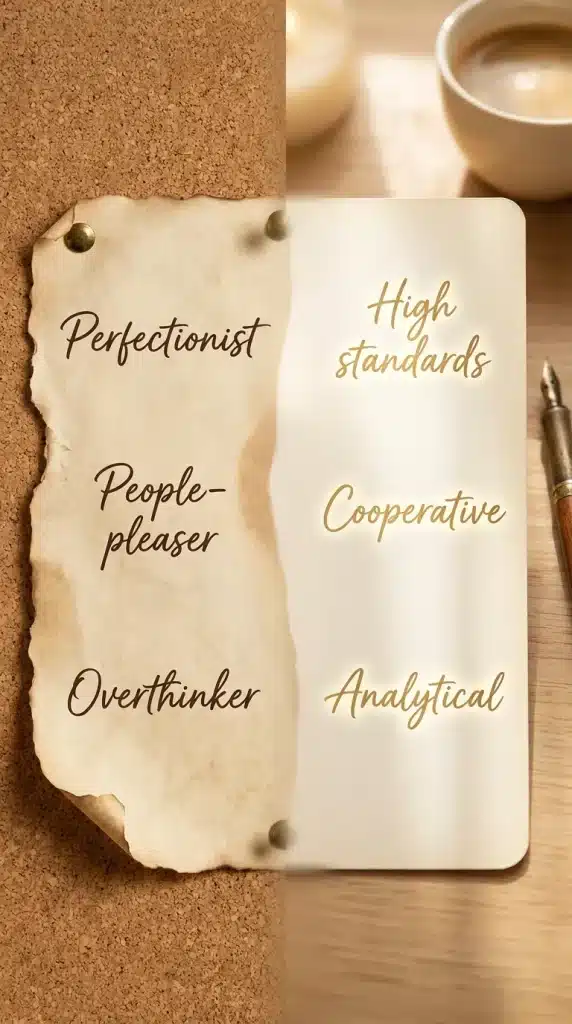
Every weakness has a flipside
With the endless catalogue of personal flaws and weaknesses I had compiled about myself, it was much easier from then on to flip a coin and find something favourable to say about myself in job interviews.
Always over-preparing for everything?
“I’m never unprepared in meetings.”
Chronic people-pleasing?
“I can find ways to collaborate with almost everyone.”
Pathological perfectionism?
“I can handle a high level of detail and always reach for high standards in my work.”
And what I said about myself in these examples is true. Even after I left the negative flip-sides behind.
It’s not about disguising weaknesses or spinning them into corporate clichés. It’s about exploring whether genuine, useful strengths may be hiding behind certain types of behaviour.

Start filling in the missing colours
I wanted to share my flip-the-coin trick with everyone who struggles with the “Tell us about your strengths” question in job interviews.
But that’s not all.
Rediscovering and reigniting your strengths can be really hard if you suffer from anxiety, depression, low self-esteem, or all of them. I know this from experience!
I have published several articles lately about rediscovering and using personal strengths, particularly as a way to prepare your toolbox if you want to leave anxiety or depression behind.
Perhaps my flip-the-coin trick can be a start for someone who finds this especially challenging. Perhaps it can help you realise that the black-and-white (or mostly black) picture your anxiety or depression paints of you isn’t true.
Start discovering your colours and fill them in.
All pictures used in this article are AI-generated illustrations. One of them resembles me at an earlier age, but isn’t a real picture.











Post Comment
You must be logged in to post a comment.