Anxiety and Depression: Why flexibility matters more than strength

If you want to leave your anxiety or depression behind, it’s often difficult to imagine the destination of your journey.
There is, however, a destination on the other side of the jungle of healing: your future self. Never forget this. Out there, somewhere, you will be living without or with less fear and sadness.
The problem is, there is no map for the landscape between where you are now and the new life waiting for you. And for many of us, this is a rough terrain to cross.
This article is about how to move in this uncharted territory.
The keyword is flexibility. In this article, flexibility means the capacity to adapt actions and expectations to reality without abandoning your direction. This is what keeps you going, not strength or stubbornness, when reality is about to crush you under its heel.
The problem with entering the unknown
It’s unknown, that’s the problem. Most of us fear the unknown, and this fear may keep us from moving. If we only had a reliable roadmap…
Is there really no roadmap to follow for leaving anxiety and depression?
There are undoubtedly enough people who want to sell you glossy roadmaps and travel companions for how to battle anxiety and depression. Some of them may offer good, solid advice; others will just try to sell cheap, useless slogans.
But the main thing is: none of them has ever been in your exact situation. Some have probably walked on similar paths, but none have been you, lived your life, or met exactly the same obstacles as you will face.
No one has ever walked your road in your shoes.
Why is it practically impossible to make a detailed roadmap?
Let’s look at a popular opinion about how to handle life:
There’s a lot in life you can’t control. But you can control how you react to things that happen.
There’s a lot in life you can’t control
This is true, beyond doubt.
All your efforts to plan and organise your life can be turned on their heads at any given moment by external events. Everything from global pandemics, acts of war, and volcanic eruptions, to the death of a dear person, or a personal or general financial crisis.
There is usually nothing you can do to control such events or prevent them from happening.
But you can control how you react
This is also true, in theory.
However, this is not the default ‘modus operandi’ of human emotional life. Your emotional reactions to anything that happens to you tend to be instantaneous and automatic, based on earlier experiences and cultural baggage.
Controlling your reactions to a certain extent requires training and awareness.
However, if you are like most people and me, this isn’t your first choice of dealing with things either. Instead, you’ll go for an illusion of control.

Creating an illusion of control
In the iron grip of anxiety, you may try to create rules for yourself more manageable than the demands of the external world. Rules for how to dress, eat, organise things in your home, wash your hands, or check if you have locked the door when you go out.
In a depression, you will often try to protect yourself by withdrawing from the world. And, as a last resort, your brain may try to numb your emotions entirely.
Scrupulously following self-created rules is the opposite of flexibility; it’s rigidity. Withdrawing and numbing isn’t solving problems; it’s suppressing them.
Although we’re talking about natural self-protection mechanisms, all of this will harm you more than help you on your way out of anxiety and depression.
So, what is flexibility?
It’s definitely not about stopping emotional reactions. Without emotions, you would be a machine, not a human.
Flexibility is adapting to events in the best possible way and tolerating your emotional reactions to them.
Cultivating flexibility will make you more resilient, protecting you from being overwhelmed by what happens to you and your emotional reactions.
A flexible attitude can give you the mental space to respond to events rationally and deliberately, rather than reacting out of pure instinct and fear.
Practical examples of a flexible mindset:
You start out taking small steps, because you know this is better than not moving. You take a break when necessary. If you take a hard blow, you can even lie flat out for a while. But you don’t quit!
If you understand you’ve gone down the wrong path, you admit it. You can adjust your goals and choose different tools and methods. But you don’t abandon our general direction!
What flexibility is not
Being flexible doesn’t mean you’re weak
We’re so used to hearing ‘advice’ like:
- “Set high goals and never ever give up on them.”
- “Don’t be a loser. Shut up and keep going.”
The thing is, being tactically flexible isn’t a weakness at all. On the battlefield, no good general would advance if there was nothing to gain from it, and he or she would retreat promptly if holding the position would cost more than the benefit of it.
Not understanding this isn’t a strength. It’s stupidity.
Flexibility isn’t passivity
It’s not self-indulgence or avoiding discomfort. Please don’t use flexibility as an excuse to do nothing.
On the contrary, flexibility is being active. It’s pushing when necessary and retreating when this is the rational thing to do. And first and foremost, it’s adapting to what happens and learning from it.
A flexible approach requires effort, but clever effort, not brute force.
How to learn and embrace flexibility
Create a room for manoeuvring
Flexibility is the ability to navigate the uncharted territories of life. It’s about manoeuvring between the obstacles and finding a possible path forward.
This isn’t easy if you’re permanently pushed to the limit!
Perhaps the first tactical move you need to do is to retreat a little and give yourself space to breathe and think?
Withdraw for a while from the family conflict you’re a part of. Allow yourself a holiday from the job that’s wearing you out. Try to put a little less pressure on yourself. It’s not necessary to be perfect in every way.
Accept the fuzziness of life
Life is complex! Millions of things that happened in the past needed to happen for you to even be born. Millions of things that have happened or are happening now have led you to where you are and will continue to influence where you go.
No simple statement can explain all of this. No single religion, ideology, or self-help theory can give you valid answers for all your questions in life. There is no one-size-fits-all solution!
I know! I know this is a bitter pill to swallow if you’re suffering from anxiety or depression. What you need most of all is simplicity and predictability.
However, I must ask one more almost impossible thing of you:
Accept that you cannot control everything
Sometimes, life seems like complete chaos, perhaps particularly if you’re suffering from anxiety and depression.
There is extremely little you can do (at least right now and on your own) about the global economy, the climate, the fact that fascism is gaining popularity again, or your narcissistic boss at work.
You may feel like a tiny feather being tossed around by the evil, invincible, and often invisible forces of the world.
Accept that the world isn’t out to get you
True, there is evil in the world. There is greed, cruelty, deceitfulness, and coerciveness. All of this originates from the inside of human heads, sometimes inside the heads of people near you, and sometimes they choose you as their victim. In most cases, this is about their insecurities, jealousy, lack of impulse control, or otherwise twisted minds, not about you as such.
Apart from this, most of the dreadful things that happen in our world aren’t about you in any way. The greedy, power-hungry, and cruel human sharks out there may be indifferent to your suffering, but they likely don’t know you exist at all. They’re not after you personally.
Nature is immensely powerful and reminds us of how tiny humans are every time a volcanic eruption, a tsunami, or a violent storm occurs. However, nature is completely neutral. There is no evil, calculating will behind even the most devastating natural disaster.
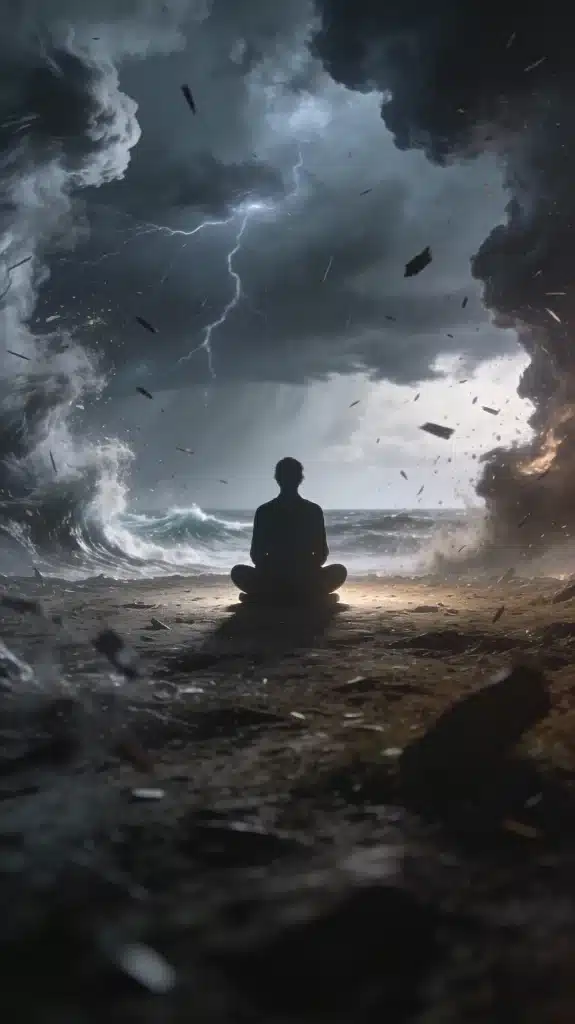
Find a reasonably quiet eye in the storm
Try to see that, behind all the chaos, the uncontrollable forces, and the unpredictability, the world is relatively neutral towards you personally.
Try to see that your anxiety and depression are something you feel, and what you feel about the world right now doesn’t necessarily reflect how the world is.
Your pain is real, beyond doubt. But your pain is an emotional reaction to something that has happened to you, not a reliable reflection of how your environment is now or how the rest of your life will be.
If you can start trusting this, the world shouldn’t look quite as mean, dark, and terrible as it did before. This is a slightly quieter eye in the storm, where you can begin looking at your options.
Look at what you can control and change
In reality, there will be many things you can control and change. Depending on your situation, they may be small things, perhaps microscopic things at first.
Remember, every small move brings you a tiny step closer to your future self. Doing nothing brings you nowhere.
Decide to get up at 9 AM if you usually sleep until 2 PM. Decide to do a 20-minute walk if you spend most of the day on the sofa. Decide not to respond to your brother’s next toxic comment.
Some actions may seem small, but may, in reality, be massive leaps. For instance, if you decide to reduce your negative self-talk.
Don’t let setbacks defeat you
Setbacks will happen, and they may happen for two reasons:
- Something outside your control happened.
- You made a mistake.
Neither of these is a defeat. They are opportunities to learn.
You will learn how to prepare better for uncontrollable future events.
And your own mistakes are always the best teacher. No great invention, discovery, or progress has ever happened without repeated trials and errors.
And a good general would say: Losing one battle doesn’t mean you’ll lose the war.
Let go of shame
Shame will always be your worst enemy on the journey out of anxiety and depression.
Being ashamed because you confuse what you feel with who you are. You may believe your anxiety and depression make you flawed, worthless, and unlovable.
Being ashamed for being ‘different’, even though anxiety and depression are obviously common in most societies. According to Mind, 1 in 5 people report experiencing a common mental health problem (like anxiety and depression) in any given week in England.
Being ashamed for not living up to other people’s expectations right now and, even worse, for not living up to your own.
You have nothing to be ashamed of if you suffer from anxiety and depression and have decided to fight your way out. I’d say you’re a hero!

Understand when people become obstacles
You don’t want to distrust people around you, but a flexible mindset also requires you to be realistic and flexible in your views of others.
People generally don’t like change. Your healing may be a change that some people don’t like.
Some people won’t trust that you know what’s best for you and will try to persuade you to do what they believe is best for you.
Some people will want you to do what’s best for them, and might try to sabotage your healing journey if this suits them.
Be aware and be flexible if this happens. Navigate between the human obstacles also.
Rise up if you’re knocked down
Oh yes, you will take a punch in the face now and then, perhaps a full knockout. It still happens to me sometimes, even though I’ve been on this journey for 20 years.
When it happens, stay down for a while, if you have to, but don’t let yourself be sucked all the way down to where you started.
Do what you need to stop yourself spiralling. Go for a run. Turn your stereo up to 11 and play old heavy metal. Get a little bit drunk, if necessary. Only you know what works best for you.
But don’t stay down there! Get up again and start moving! I know it hurts right now, I know you’re battered and bruised, but there’s someone waiting for you: your future self. Please don’t let him or her down!
Flexibility is how you survive—and how you arrive
Arrive at your future self.
There is no heroic final charge out of anxiety and depression. No decisive victory, no clean ending. There is only movement—sometimes forward, sometimes sideways, often painfully slow, and sometimes you slip backwards as well.
Flexibility is what keeps you alive in the terra incognita, the unknown land, of healing.
If you take one thing from this article, let it be this:
You do not need to be strong every day.
You do not need to be brave every moment.
You do not need to know the whole road.
You only need to stay flexible enough to keep going.
The existence of your future self depends on this, on you not giving up.

So move when you can. Rest when you must. Adjust goals and methods when reality demands it.
And even when you fall—and you will—fall forward towards your future self.
This is flexibility.
This is survival.
This is how you get out.











Post Comment
You must be logged in to post a comment.