We’re Wired to Belong: Why we need other people
One day, a few years ago, I was reflecting on my past. You know, I always have this strong urge to understand; I want things to make sense!
And I was thinking, what was the worst part of it all? Was it the constant stress of anxiety? The pitch black frost of my depressive periods? The chronic physical pain, perhaps?
No.
This was when I experienced a revelation of earthquake-like magnitude. The absolutely worst thing about the first 55 years of my life had been the loneliness. Nothing had even been remotely comparable.
Nothing.
Okay, but I’m not exactly a social butterfly, am I?
True. So why do I complain about loneliness? Didn’t I choose solitude many times? Wasn’t I reluctant and inhibited in social settings? Wasn’t it, at the end of the day, my own fault if I felt lonely?
I will definitely return to this, don’t worry.
Let’s first look at why this realisation about loneliness was such a mental earthquake for me. What changes fuelled this revelation? Let me briefly describe:
My social revolution (all inside my mind)
Self-esteem catching up with self-confidence (slowly)
A part of me always knew I was skilled at my job. I continually learned, earned certifications, and effectively solved problems for customers and employers.
Another part of me was the walking host of a well-developed imposter syndrome. I was always scared that someone, somehow, at any time, could expose me as a fraud.
Slowly, around the time I turned fifty, my self-esteem started to catch up with my self-confidence at work. However, it still lagged behind in my private life.
Suddenly being good enough for someone
This changed drastically in the summer of 2020.
On the 9th of July that year, I started exchanging messages with the then-unknown person who is now my wife. I have written about what happened in this article:
Suddenly, I was good enough for someone, unconditionally, even though I hadn’t met this person in real life, even though neither of us had been looking for anything but someone to talk to, even though neither of us could know it would ever be anything more than this.
This mental revolution was all I needed to start standing up for myself, for the first time in my life.
Becoming a warrior (out of necessity)
Just before Christmas 2020, I had to utilise my newfound ability to stand up for myself and others.
I agreed to take on the challenge of managing a team that had been underfunded, understaffed, and underdeveloped for years – all in the midst of the COVID-19 pandemic. God, I was on the front lines every day fighting to keep things moving and still protect ‘my boys’ in the team.
In the middle of the battle cries, to my bafflement, I discovered I was actually listened to, all the way from the ‘factory floor’ to the board of directors. Not everything I said was popular everywhere, but I felt respected.
Imagine that!
An unexpected box of dynamite
A couple of years earlier, my only hope had been to grow old with an acceptable level of dignity. This was my only remaining aspiration in life. Not so anymore. I had never been particularly afraid of dying, and neither was I now.
However, I did feel a new fear: of not having lived.
My recently discovered capability to stand up for myself, my newly acquired taste for respect, and my freshly developed faith that change was actually possible, combined, were an unexpected box of dynamite not compatible with my then-marriage.
I moved out in June 2021.
Rediscovering myself
Through all of this, I had to reconsider my beliefs about myself every day.
I had always considered myself a true introvert. I still do, although my understanding of what it actually means to be introverted changed dramatically. I’ll write more about this elsewhere.
Furthermore, for years, I believed I was on the autism spectrum, somewhere in the Asperger’s area, feeling I had serious problems with understanding other people’s intentions and (particularly non-verbal) communication.
It turned out this was as far from the truth as it could get. Yes, overload and social anxiety had earlier made a mess out of my brain in almost any social situation. But now, standing on firmer mental ground, I discovered I had massive aerials for human communication, and I can pick up tiny details that many people miss.
Solitude vs. loneliness
This still doesn’t make me a social butterfly, though. Even with the social anxiety out of the way, I’m not. However, this is now more a matter of choice than inability and inhibition.
So, what about solitude, which I earlier sought at every possible occasion? Doesn’t this define me as a loner? Doesn’t it prove I wanted to be lonely? If you even think like this, there are two things you need to know:
- Solitude is being physically alone, often by choice. Loneliness is being emotionally disconnected from others, even in the midst of a crowd, involuntarily. They are two completely different things.
- A perceived need for solitude may, in many cases (including mine), be a need for a safe environment to recharge and recover, and not necessarily a need for being physically alone.
Solitude had been my only known safe environment since childhood until the 3rd of September 2021.

The natural state of being human
On this day, I met my English online “penfriend” in person for the first time, and from that moment on, I never longed for solitude again. I have only wanted to be with her.
And I understood why all my previous moments of solitude, although necessary for my health and sanity, always felt hollow. There was something unfulfilled in them, a thirst that could never be quenched, even though I did my best to quench it with alcohol already from the age of thirteen onwards.
Because the natural state of being human is to be with someone. Safety lies in being with the right people, not in being alone. And I had spent nearly five and a half decades of my life without knowing, even though this is what we are made for. This is our human speciality more than any other species.
Why? Actually, this makes me think of…
Personal computers in the 1980s
Now you probably think I’ve gone totally off the rails, but bear with me.
The microprocessor was the brain of the 1980s personal computers. However, these microprocessors had a relatively limited set of things they could do efficiently.
If someone needed to perform more advanced calculations and their computer was equipped for it, they could have a math coprocessor installed. Likewise, as computer screens improved and people demanded better graphics, a graphics coprocessor could be installed in some computers.
This is more or less similar to how the human brain turned into…
A social supercomputer
Evolution has endowed us with several social coprocessors, more numerous and larger than those of any other known species.
A reptile whose summit of social life is incidentally meeting a member of the opposite sex once a year, mating, laying a nestful of eggs, and leaving the offspring on their own to hatch and grow up, well, this reptile doesn’t need much of a ‘social processor’.
A mammal that lives in a herd with a social pecking order while looking after their offspring for an extended period obviously needs more.
Humans take this to a new dimension, living in a coordinated way with thousands of other people and raising children until they are twenty years old or more.
Evolution has gradually developed new ‘social coprocessors’ as needed on our way from reptiles via mammals to primates and Homo Sapiens. Here are a few examples:
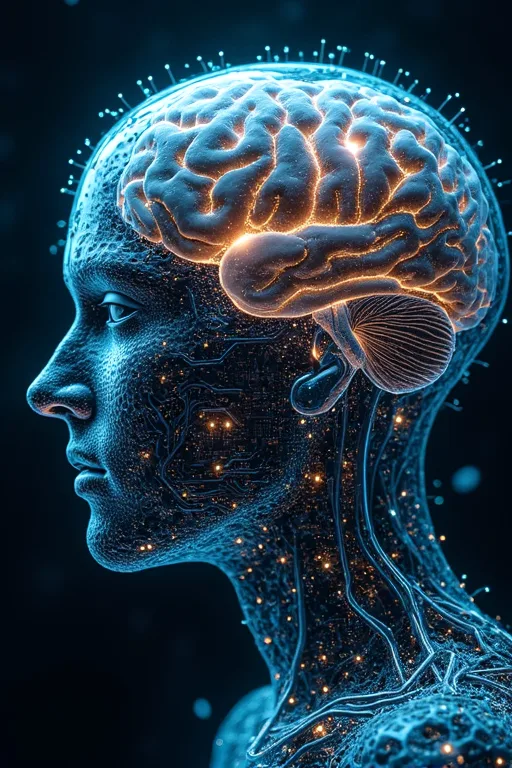
The prefrontal cortex
No other species on Earth has a more developed prefrontal cortex than we humans, and here are some of the things it does:
- Understanding social norms and expectations.
- Empathy and moral reasoning.
- Understanding and predicting other people’s behaviour (theory of mind).
- Planning, organising, and strategising.
- Inhibiting inappropriate impulses.
- Adapting to new rules.
- Assessing risks and rewards.
- Suppressing fear and anger when appropriate.
Mirror neurons
These cells can be found in several areas of the brain and activate both when we act and when we observe someone else performing the same action. They help us to:
- Understand other people’s actions.
- Imitate and learn from what others do.
- Empathise with others.
- Understand non-verbal communication (body language, facial expressions, tone of voice).
- Understand other people’s intentions.
Language
While other species have prefrontal cortexes and mirror neurons of various sizes and numbers, there’s no doubt that advanced language skills are uniquely human. If I had to point to one thing that defines us as a species, I would say our language and communication skills.
Many regions of our brains are involved in language processing, as if evolution had to install several language co-processors to make us what we are today.
We were built to be social animals
Oh, not only built, but specialised, honed, and fine-tuned to be highly social animals. All of the above would be meaningless and totally wasted if we were ‘intended’ to be hermits.
But there’s one more thing:

Our (almost) never-ending childhood
The brains of the species said to be our best friends, namely dogs, are fully developed after 12 – 24 months, depending on their size and breed.
Chimpanzees, with whom we share 98% of our gene pool, reach full neurological adulthood after 13-16 years. As with us, the girls mature a little quicker than the boys.
For us, the prefrontal cortex isn’t fully developed until we are around 25. Even though we are physically and sexually mature years earlier, we need about a decade more to grow our brains up than our close Chimpanzee cousins.
This isn’t because we humans are daft. It’s because we have an extremely large amount of wiring to complete to get our social processor fully operational. But when it is done, every one of us has built a social supercomputer powerful enough even to enable us…
To agree on things that don’t exist
Yes, we can even agree with millions of other people on the existence of things that don’t really exist, if it helps us organise our social interaction. No, I’m not going to discuss religion this time. However, let’s look at a couple of other examples:
The imaginary value of money
Initially, the value of a coin was the value of the amount of metal it was made of. One pound sterling was the actual value of one pound of silver. But gradually, we agreed that
- One pound was still worth a pound, even if it was made of a copper alloy.
- A worthless piece of paper called a ‘banknote’ could also be worth a pound.
- And (more recently) that a digital number in a bank’s computer system is also worth a pound.
The communal agreement on the value of money makes the exchange of goods and work hours much easier than exchanging a sheep for two barrels of salted herring.

Our imaginary borders and groups
If we humans hadn’t (generally, but not always) agreed on it, there would be no such things as England, Norway, or Europe. Of course, the land would be there, with its plains, rivers, forests, and mountains, but the concepts of countries and nations are merely constructs of our minds.
We agree on these mind-constructs to make it possible to organise and manage millions of human lives. If we can’t belong to a small tribe anymore, we can at least be raised to belong to a vast nation!
Agreeing to hate for imaginary reasons
This happens often, I’m afraid.
For instance, we may begin to see our membership in one imaginary group of people (such as a nation, or even a football fan club) as a reason to start hating and killing people who are members of other imaginary groups of people.
No other species can organise themselves in large numbers as humans can, based on our capacity to agree on abstract ideas. And sadly, this backfires terribly sometimes.
The beauty, power, and danger of words
As with other constructs of the human mind, the sounds of speech and the symbols of written language are only meaningful because we have agreed on what they mean. And without language to communicate the ideas, none of the other imaginary things we have agreed upon would ever have existed.
Words can persuade millions to go to war and perform the most horrible crimes.
Words uttered 2,000 miles away or 2,000 years ago can teach us wisdom and dignity, and make us better people.
Words can express love in a way that nothing else can, and form lifelong bonds of partnership and devotion.

Loneliness: the absence of connection
The human social supercomputer-brain is supremely wired for creating and maintaining bonds with other people. We are made to connect, belong, communicate, collaborate, and love.
What are the supercharged neural engines inside our heads going to do if they don’t have any social connections to work on? Exactly. They don’t know what to do. They get confused, upset, and, in the end, we fall ill.
The health impact of loneliness
Loneliness isn’t just an obscure feeling. Solid scientific research has shown that long-term loneliness represents a clear mental and physiological health risk.
This article from The Campaign to End Loneliness refers to research concluding that long-term loneliness has “a damaging impact on our mental health” and “can increase the risk of early mortality by 26%”:
Connecting up
My own 55 years of loneliness probably didn’t do me any favours, then.
But still, how can a person go through decades of life like this, living with a variety of people, meeting and dealing with thousands of people, and still feel lonely if it’s not this person’s own fault? There must be something wrong with him!
Let me repeat: Loneliness isn’t the same as solitude. Loneliness isn’t about having people around you or not. Loneliness is the absence of real connection.
The thing with any connection is that it has two ends. It is anchored in two people. And for the connection to work, there must be a sufficient level of compatibility between the two. To use a technical metaphor: the plugs must fit in both sockets, and the right signals must pass through for the connection to work.
But how can we know if the connection works?
Yes, now we are at the core of my problem for 55 years. How could I know how a deep, trusting, loving, and rewarding connection with another person was supposed to work if I’d never really had one?
Sadly, I believe many people live their whole lives without this knowledge.
We feel that things aren’t quite right in the relationships we’re in, but we can tolerate it; at least we don’t murder each other — and who knows what would happen if we left?
Fear of the unknown keeps us in our place, and then habit kicks in. As we know, habits are hard to break, even if they’re harmful.
So, this is what I’ve learned from life regarding human connections:
- If a connection doesn’t feel quite right, it most likely isn’t. We must trust our instincts more than, for instance, social pressure and conventions.
- You will know it when you establish a connection that really works, because it feels like finally being allowed to breathe after a long time of suffocation.
It’s all about finding the right people
Yes, but who are they?
This question is big enough for an article on its own.
However, most of us need someone. Some of us crave deep connections with a few, perhaps only one, while others prefer more superficial connections with many. But very few of us can live healthily and happily in complete loneliness.
Because this would be against human nature. When we are lonely, we are like stranded fish. We have ended up in a situation we aren’t built for.
All pictures used in this article are AI-generated illustrations. Some of them resemble me and my wife, but they aren’t real pictures.











Post Comment
You must be logged in to post a comment.