Chosen ignorance is the only true stupidity

“Søkki, korr dum du e!”
In my childhood language, the Trøndersk accent of Norwegian, this means, “Damn, how stupid you are!”
I heard people saying something like this to me or to others several times a day when I went to school. Not that I was spared at home. I’ve written about one specific example in this article:
In the culture where I grew up, speaking negatively about others was ‘normal’. It was expected. ‘Others’ could be gay people (although no one would admit they were), people of colour (a rare sight), people of other religions (never met any back then), women in general, or even people from the neighbouring villages.
The thing was, if someone stood out in any way from what was ‘normal’, you had to speak negatively about them. If you didn’t, it may have been taken as proof that you were ‘one of them’.
But why were people accused of being stupid?
Well, I think accusations of being “dumb” (stupid) were the default option people fell back to when they couldn’t find anything else to bully you for. The negative talk wasn’t their goal in itself. It was just their standard means used to maintain the social pecking order.
If you weren’t coloured or (suspected of being) gay, if you didn’t wear unusual clothes, if you didn’t get too good grades at school (or too bad), if your parents weren’t too rich or too poor, or were more educated than the rest, or held any unusual political views, then there was always the possibility to label you stupid.
If there was something you hadn’t heard about, you were stupid.
If there was something you didn’t understand immediately, you were stupid.
If there was a practical skill you didn’t master, you were stupid.
If your opinions differed slightly from your peers’, you were stupid.
“Søkki, korr dum du e!”

Stupidity across the borders
English speakers will, of course, recognise “dum” as the same word as “dumb”, not in the sense of lacking the ability to speak, but of being ignorant, stupid, or foolish. The Germans and the Dutch both have the same word: “dumm” and “dom”, respectively.
When the same word is to be found in English, German, Dutch, and the Nordic languages, it’s fair to presume it’s an old word and a word that’s been regularly used all over the Germanic language area.
It seems to me that the way people talked about each other where I grew up wasn’t totally unique for that time and culture. And today, even the President of the United States is relentlessly pointing out other people’s stupidity.
The Bible says something about seeing the speck in someone else’s eye but ignoring the plank in our own, but that’s not the theme of this article. I’ll just stick to the nature of stupidity.
What does it really mean to be stupid?
Stupidity as in being uninformed
For 2000 years now, Christians have discussed whether ‘heathens’ (non-Christians) who have never heard of Jesus will be condemned to Hell in the afterlife. Even today, many Christians claim this is what happens. I hope not. It would make the Christian God seem less than merciful, I think.
Of course, the state of being guiltlessly uninformed about something, not having had access to the information necessary to be informed, is not a sin. Nor can it be a sign of stupidity.
If anything, it’s a state of innocence.
Still, not knowing something people deem ‘normal’ to know quickly earns you the label of being stupid. This was an everyday experience when I grew up. Even today, as a grown-up immigrant, I sometimes feel that people look at me as a bit less than intelligent if I miss out on some of the tiny but essential details of ‘how to do things in England’.
Stupidity as in lacking practical or academic skills
Two specific examples of being uninformed are a lack of practical or academic skills.
Where I grew up, certain practical skills were essential for being considered ‘normal’, and you were in for ridicule, likely bullying, if you didn’t master them. Among the skills expected of boys, playing football and repairing engines are examples of things I didn’t master well myself.
Sadly, I’ve later seen the same arrogance and judgmentality in academic circles. I worked for around 20 years in a university environment where there traditionally was a clear division line between students of science and humanities. And many people from both sides of that border apparently (and sometimes outspokenly) looked at ‘the others’ as more stupid than themselves.
While lacking practical and academic skills can perhaps be described as ignorance, it’s not a sign of stupidity. However, I’d say that some of the behaviour I’ve seen from both people highly adept at practical skills and from people with PhD-level education clearly was.
Stupidity as in being unable to understand
We are all born with different capacities for learning, acquiring skills and knowledge, and understanding the world around us.
In the 1994 film ‘Forrest Gump’, the main character, played by Tom Hanks, had some limitations in this area and was looked upon as stupid by many people. However, Forrest showed a level of determination, empathy, and loyalty that few others possessed. Yes, Forrest was a fictional character, and the story of his life may not have been realistic. But people with limited intellectual capabilities are bullied in real life, and it’s not fair.
“Stupid is as stupid does,” Forrest often said. And I’d say that the apparently affluent man in a big Audi who yesterday overtook me at speed just before a hilltop on a narrow country lane was way more stupid than most of our real-world Forrests.
Stupidity as in being different
As it turns out, it seems that on most of the thousands of occasions I’ve heard people use the word ‘stupid’ about me or another person, it hasn’t been about this person’s intellectual capabilities at all.
It’s just a way to express, “You’re different from us, which means we’re better than you. Make sure you stay in your place.”

However, what about the plank in my eye?
Yes, because I sometimes use the S-word about people, too.
What does stupidity mean to me? When do I find it justified to label someone stupid? Apart from the Audi driver I mentioned above and many others I see on the roads who have absolutely no concept of the risk they are exposing themselves, their passengers, and everyone else on the road to.
There is one thing in particular:
Stupidity as in chosen ignorance
To not know because you haven’t had access to the information in question is innocence, not stupidity.
Failing to acquire skills and knowledge that we know are available leaves us in ignorance about the theme in question. But is this stupidity? Not unless refusing to develop the knowledge in question is harmful to ourselves or others.
“True ignorance is not the absence of knowledge, but the refusal to acquire it.”
– Karl Popper, Austrian-British philosopher
However, refusing to gain knowledge despite having harmful, judgmental, discriminatory, and narrow-minded opinions is a choice many people make. Although a wealth of information is available, many people choose to adhere to a simplified worldview, often one shaped by individuals with specific political or religious agendas. They cling to this worldview, regardless of the evidence that contradicts it.
This is what I call chosen ignorance, and it is:
Stupidity as in laziness
A high volume of migration can be a challenge in many ways for a society. But can migrants really be blamed for every single problem we have, including the fact that my cousin cannot find a job, the amount of potholes in the lanes around my village, and the scam messages I receive on my phone? The answer is yes if we trust the comments left on many social media groups and online forums.
Another thing: Many people I knew 45 years ago, who then were curious and explorative, who embraced the fuzziness of life, and flexibly learned from the twists and turns of their path through it, seem to have gone rigid at some point. Now they seem to compete about having the most uncompromising, conservative points of view.

Some people go all the way, discarding every sensible piece of information available, and dedicating themselves fully to being conspiracy theorists, flat-earthers, and believers in Odin and Thor (Viking gods).
Why?
Because they are basically and thoroughly lazy.
Stupidity as in renouncing the complexity of life
Life is complicated. The world is complex. And what we know for sure today may have developed and changed tomorrow. It’s hard work to stay on top of it all.
This is where I believe many people take the easy way out: they choose a simplified model of the world for themselves.
“One of the most cowardly things ordinary people do is to shut their eyes to facts.”
– C. S. Lewis, from The Voyage of the Dawn Treader — the fifth book in The Chronicles of Narnia series.
For instance, a model where muslim migrants are the sole reason for every single challenge of our lives. Or, a model based on a perceived ‘golden age’, where everything was predictable and straightforward, where men were the unchallenged authority and breadwinner of the family, where women lived most of their life (pregnant) in the kitchen, and children were obedient, invisible, and inaudible.
The problem is, the world never is or was black and white. And simple ‘golden ages’ are mostly myths. But why take on the hard work of understanding an ever-changing, complex world if you can comfortably live your life in the embrace of an Atlantis myth, looking out on it all through monochrome glasses, and blame someone else for everything that rubs you the wrong way?
Why, when you can choose comfortable sluggishness?
Vive la Resistance
True, we all have built-in barbs, an internal la Resistance, trying to protect us against the complexities of the world.
For instance, the confirmation bias that leads us to interpret new information in ways that confirm our existing knowledge, often resulting in the dismissal of information that contradicts our worldview.
Oh, and what about the Dunning–Kruger effect? It’s scientifically documented that people with a low level of knowledge tend to overestimate their competency, while people with a high level of expertise tend to underestimate it.
“The whole problem with the world is that fools and fanatics are always so certain of themselves, and wiser people so full of doubts.”
– Bertrand Russell, British philosopher
I believe this creates a self-amplifying spiral. The less people (choose to) learn and the simpler a worldview they select for themselves, the more competent and confident they feel. Why should they bother to learn anything at all from other people, who mostly are idiots anyway?
You can’t find more confident people than those of my peers in age who decided sometime in the 1980s that they had learned everything worth learning and whatever happened afterwards was irrelevant or, yes, stupid.
A self-confidence purely earned through laziness, but often loudly expressed.

Regrets and a shameless verdict
Beyond doubt, I owe an apology to the children I called stupid when I was a child myself. No child deserves to be treated that way, and I’m sorry. It’s an explanation, but not an excuse, that the culture encouraged us to talk like that and sometimes punished us when we didn’t. I hope I didn’t say such things too often, and I know it felt wrong every time. But still, I’m sure it happened.
And to those who found joy in consistently trying to convince me I was stupid (and ugly and worthless):
They tried hard, I’ll give them credit for the effort. I remember it well, you know. But they never convinced me entirely, and I believe I gained some wisdom from what happened. I’m not sure they can say the same.
I have met some of them later in life, and I’ve noticed that most have settled well into a oversimplified worldview, where the nuances and colours of the world don’t have much of a place, where harsh opinions and loudness matter much more than knowledge, where platitudes are favoured over truth any time, where hurting and insulting others still is a perverse but inexhaustible source of ‘self-inflatement’.
Ah, well, I’ll admit without shame that this makes them utterly stupid in my eyes.
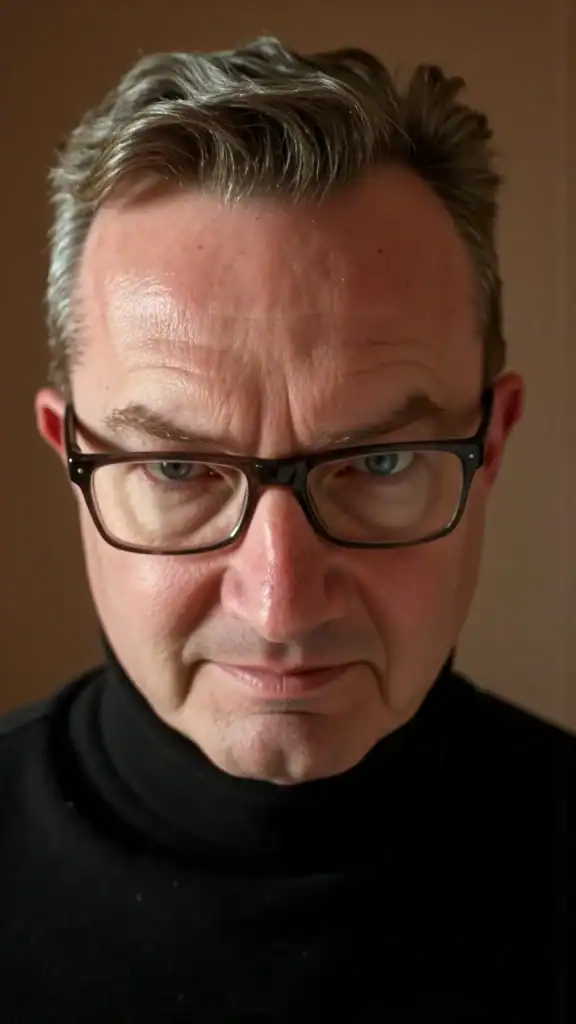
All images used in this article are AI-generated. Most of them resemble me, but aren’t real pictures.











Post Comment
You must be logged in to post a comment.