Anxiety and depression: How to know when self-therapy isn’t enough
When suffering from anxiety or depression, there might be many reasons why we resist seeing a therapist, for instance:
- It would feel like a defeat because we should be able to cope on our own.
- It’s terrifying to talk about emotions (especially for us middle-aged men).
- There are no good therapists available in our area.
- We can’t afford it anyway.
Furthermore, it’s not always necessary to see a therapist when we’re not feeling well. Sometimes, things will ‘just’ get better.
Grief, for instance, is a natural response to losing something or someone we hold dear and a process that needs time and patience.
The sadness we feel when grieving isn’t depression, and the fear we feel when facing danger or uncertainty isn’t anxiety. It’s just our brains doing their jobs to help us survive. Things are supposed to return to normal when the grieving is done, and the threats are gone.
However, sometimes, they don’t.
In this article, we will examine:
- How the natural emotions sadness and fear turn into anxiety and depression.
- How to know when self-therapy isn’t enough and professional help is necessary.
Why do natural sadness and fear turn into anxiety and depression?
Yes, sometimes they get stuck in our minds.
Why? I believe this often, but perhaps not always, is about helplessness. If we have a feeling of agency, if we feel we are reasonably in control of the situation triggering the sadness or fear, the probability of getting stuck in anxiety or depression is much lower.
Fear is natural when we face real or perceived danger, a part of our ‘fight or flight’ response. If we can defend ourselves or run away, well, then we can let go of our fear afterwards.
But what if we can’t do anything about our situation? What if both fight and flight are pointless?
The fear will get stuck. It will turn into anxiety.
And if this continues, our minds have a final measure to try: freeze. Depression.
The journey out of anxiety and depression
This was my simplified explanation of how anxiety and depression are born in us. It’s more complex and diverse than this, of course. The human mind and human lives are complex. However, I still believe the feeling of helplessness plays an essential part in the emergence of anxiety and depression in most of us.
The feeling of helplessness doesn’t always mean we are helpless, though. Yes, we might have been helpless in the situation that triggered the fear, grief, fight, flight, and freeze. But we aren’t necessarily incapable of doing something to start the healing journey.
This ‘something’ doesn’t include sitting on our hands, hoping it all will just go away. Because it usually won’t if anxiety and depression have established themselves as our default state of mind.
Human interaction, care, and empathy are essential for healing in most circumstances, especially for healing the wounds of the mind. But because professional therapy isn’t always available and because we sometimes can’t face or afford it, I’ve dedicated several articles on deliberate.one to self-understanding and the possibilities for self-care.
When self-therapy isn’t enough
However, if we are going to look after ourselves, we also must know the limits of our capabilities. This goes for everything from surviving in the wilderness to exploring past trauma. When we’re out there alone, we must put safety first. That’s unnegotiable.

Before doing anything, we must consider what we’re up against.
Assessing the traumatic experiences
We can roughly say that the stress of the situation that created the wounds inside us, the trauma, has two properties:
- The intensity of the stress.
- The duration of the stress.
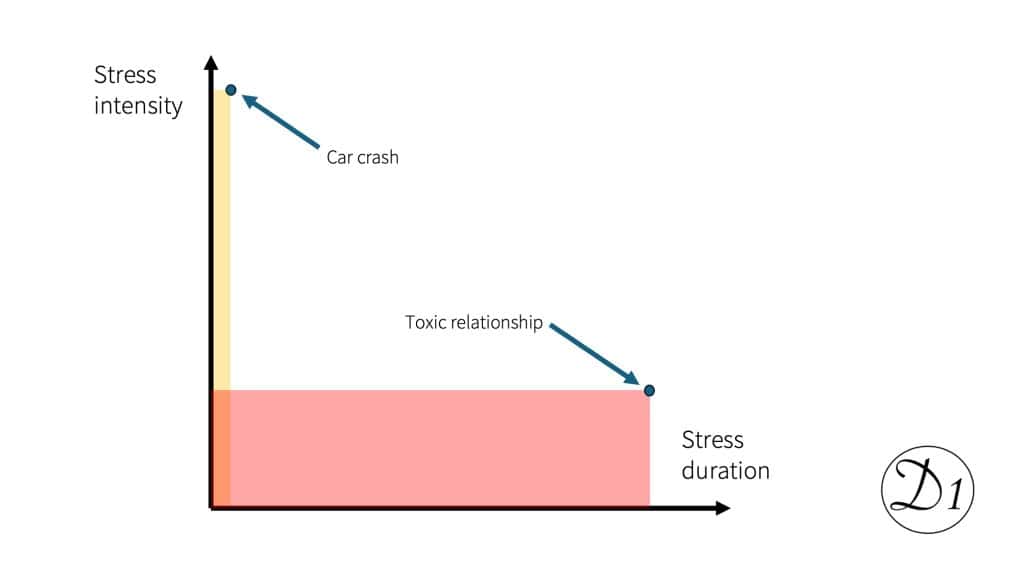
In this example, the intensity of the car crash situation is drastic but lasts only for a moment. The intensity of a toxic relationship might be minuscule in comparison, but it may last for years. Depending on our personality and the degree of helplessness we feel in the situation, the latter situation can create more harm than the first.
The more extreme the intensity of your traumatic experiences were, or the longer they lasted, the higher the probability that you should stay away from DIY therapy. Seek professional help!
Respecting the trauma symptoms
If our past experiences have caused mental trauma in us, the hallmark of it is that we’re stuck in fight or flight mode. We are constantly vigilant and react to pretty much everyday situations as if they were dangerous; we are easily overwhelmed and often tired. That’s life for many of us.
In my experience, this doesn’t necessarily mean that professional help is required. But we must consider our capacity to handle the situation. I didn’t when I decided to launch a crusade against my traumatic experiences six years ago, and it could easily have ended less than well. I’ll return to this.
However, here are some red flags that cannot be overlooked if you’re considering self-help solutions:
- Uncontrollable flashbacks. A flashback isn’t just remembering the event in question; it’s reliving it, often as fragmented sights, sounds, sensations, and emotions.
- Suicidal thoughts and high-risk behaviour.
- Your life is falling apart. For instance, relationships break up, you lose your job, or your health is seriously impaired because of the trauma you are suffering.
These symptoms indicate clearly that you are trying to handle the effects of severe trauma and must seek professional help!
Finding unbreakable bunkers
Sometimes, exploring our minds in self-therapy feels like digging in the garden. Suddenly, our pickaxe hits the hard concrete wall of an old military bunker. The wall turns out to be unbreakable. We just can’t make any more progress.
The wall might be an assumption (such as ‘It’s all my fault! I’m a bad person!’) so ingrained in us through all our lives that we can’t let go of it. Or, the wall may have been built by our own mind to protect us from remembering particularly upsetting experiences. Read this article for more information about such defence mechanisms:
Be careful if your mind frantically resists being explored. Blasting through the resistance is risky. Your mind might have good reasons for resisting. Consider seeking professional help.
To know when to stop
The problem is that we don’t always know what we’re up against.
We might be stressed out, anxious, and depressed and still be able to heal ourselves. However, during our self-exploration, we might encounter buried memories or assemble fragments into bigger pictures that trigger reactions outside our control.
Again, whether we are out in the wilderness or exploring past trauma on our own, we must be able to monitor ourselves to know when things get too hard to keep pushing on. It’s essential to know when to stop.
If you are doing DYI therapy, you must know when to stop before you’re past the point where you should have stopped. If you can’t perform this level of self-monitoring, you should seek professional help.
When I nearly broke my back
As I wrote in the article The distant song of a forgotten child, I engaged heavily and deliberately in self-therapy in 2019. I gained a lot from it, but it also nearly broke my back (metaphorically speaking).
In hindsight, I obviously had more willpower and courage than wisdom. Being wise, aware, careful, and self-empathetic is essential for anyone trying to solve their problems with self-therapy.
I still have more exploring to do in my mind, but luckily, I’m (slightly) older and (hopefully) much wiser now. Stay tuned 🙂
- Stay safe.
- Small steps are always better than ‘brute force’.
- Be aware and pull back before it gets too much.
- Know when to stop.
- If you need help, get help.
I’m not a doctor, therapist, or other healthcare professional. Please remember that my advice is never meant to replace any healthcare professional’s treatment or advice.
I’m just an ordinary man who wants to make my own experiences count by helping others in similar circumstances understand their situation and never lose hope. There is almost always something we can do, and there are reasons to be hopeful.
All pictures used in this article are AI-generated illustrations. One of them resembles me, but isn’t a real picture.











Post Comment
You must be logged in to post a comment.